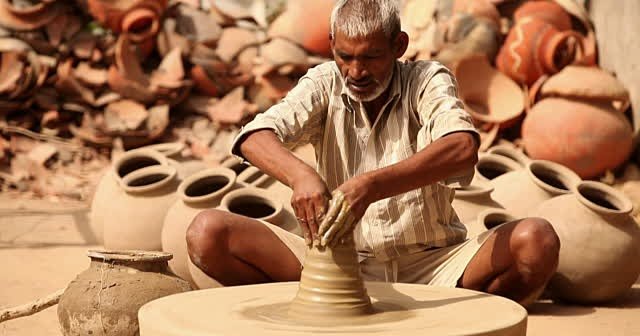
The Prajapati caste is also known as Kumhar. It is a prominent Hindu artisan community that spreads across India, which is categorized under the OBC. It is a traditional artisan caste which is associated with occupations like pottery or sculpture. Historically, their job is pottery, which helps in idol making and creating other household items.
Prajapati is a term that comes with the meaning “Lord of creatures”, which is linked to the creator deity as per the Hindu texts. They come with various Gotras such as Gautam, Kashyap, Atri, Bharadwaj and Vishwakarma.
Know about the social and cultural influence.
They follow Hinduism, and their Kuldevi (ancestral goddess) is Shriyade Mata. One of the significant rituals that the Prajapati caste follows is the Chaak Puja in weddings, where the Groom’s family visits the Potter’s house to worship the potter’s wheel, which symbolizes the start of a new life.
What do origin and mythology say?
- Lord Brahma’s blessings
According to one popular legend, Brahma has been awarded the Title “Prajapati” to a potter who was highly devoted to his work, so that once he forgot to eat the Sugarcane that Brahma gave him.
- Sub castes or groups
The caste has been divided into various groups like Ajmeri, Maru and Khambati in Gujarat, while there is a sub-caste named Kannaujia in Bihar and Uttar Pradesh. Apart from the name Prajapati, they are also known by names like Kumbhar, Kumawat, Kulala and Ghumiyar.
- Occupational roots
Their traditional occupation was sculpture and pottery, which includes five main elements. These elements are earth, water, fire, air and space that help in creating essential household items.
- Modern social and legal classification
In the modern Indian reservation system, the community has been classified as Other Backward Class (OBC). In most states, like Madhya Pradesh, Rajasthan, Gujarat and Odisha, the caste has been classified as OBC under the central list of OBCs.
Also, there are many regions like Uttar Pradesh where the Prajapati caste has been added to the SC list to fix the historical socio-economic disparities. ‘
Regional distribution and subgroups!
The community is categorized into various subgroups based on region.
- In Rajasthan, subgroups include Marwara, Timria, Kheteri, Mathera and Mawalia.
- In Gujarat, the list of groups includes Gurjar, Varia, Mistry and Vatalia.
- Punjab, the cast has been known as Bagri or Maru Kumhars. Also, in terms of occupation, many of them have transitioned from pottery to farming, along with various other occupations.
- In Maharashtra, they are known as Maratha Kumbhars, who are prominent in various districts of Maharashtra, known as Pune, Satara or Kolhapur.
Evolution of the Prajapati caste!
- In today’s time, the Prajapati Caste is spread across India, especially in various states like Gujarat, Uttar Pradesh, Bihar and Rajasthan.
- While some are still in the occupation of pottery, many have chosen other occupations after completing their education. There are people of the community present almost everywhere, from government services to private organizations.
- The caste not only works to preserve its heritage of craftsmanship but also evolves according to modern India.
Conclusion!
Originally, the Prajapati caste was related to the creation, artistry and spirituality. They choose to create lots of household items, but now, they can be seen in multiple other working sectors.