There is an old saying among riders: “Four wheels move the body, but two wheels move the soul.” In 2026, the motorcycle industry is witnessing a massive technological renaissance. From the silent power of electric superbikes to the rugged charm of modern retros, the bond between a rider and their machine is stronger than ever.
Whether you are a seasoned “grease monkey” or someone who just dreams of the open road,
the history and engineering of motorcycles are fill with incredible tales of speed, survival, and pure genius. These aren’t just vehicles; they are triumphs of physics and human spirit.
Buckle your helmet as we dive into the Top 10 fun facts about motorcycles that every enthusiast should know.
1. The First “Motorcycle” Was Actually a Wooden Bicycle
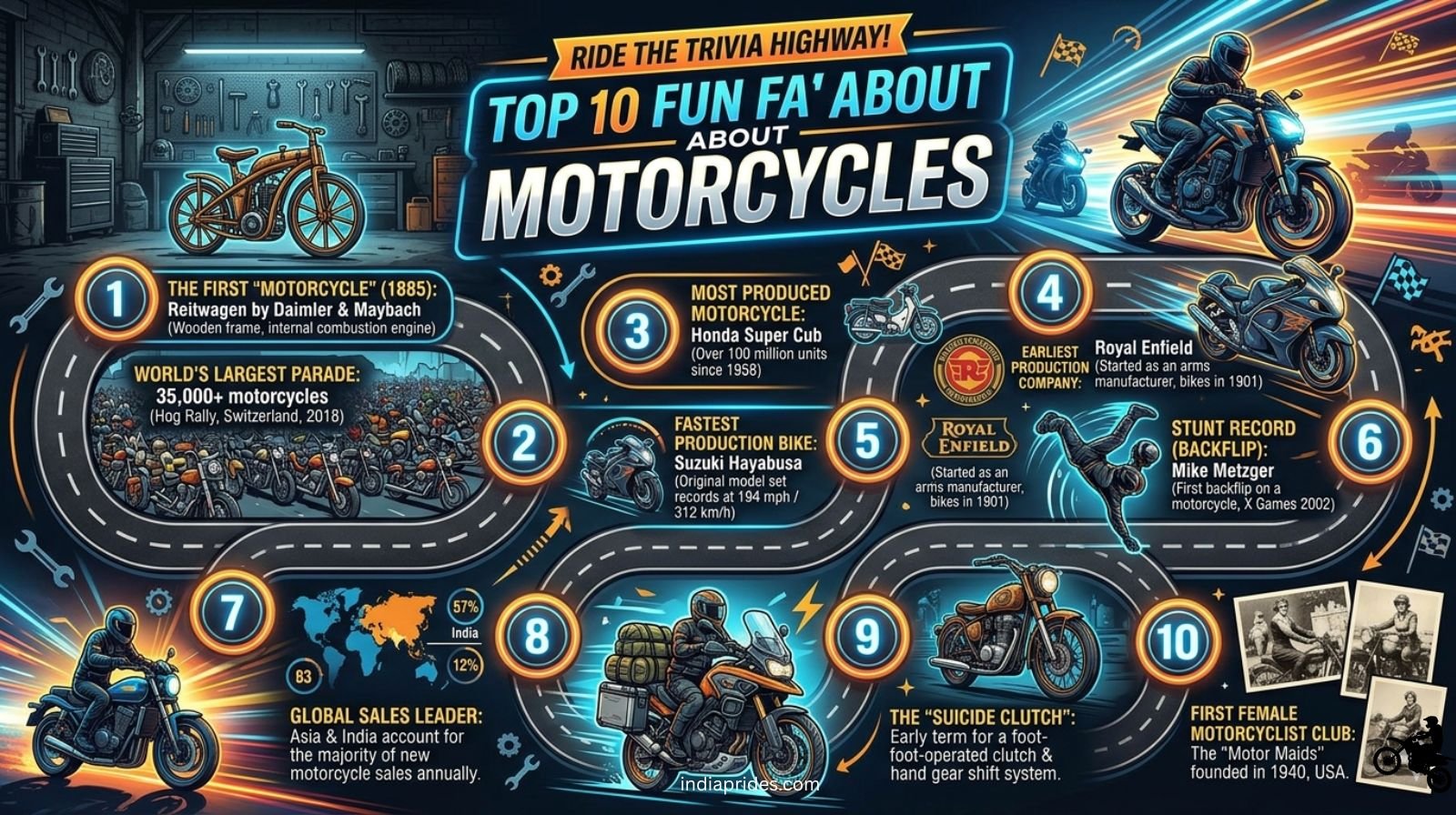
Before the roar of a Harley-Davidson or the scream of a Ducati, there was the Daimler Reitwagen. Invented in 1885 by Gottlieb Daimler and Wilhelm Maybach, this machine is widely considered the world’s first internal combustion motorcycle.
- The Twist: It was made almost entirely of wood. The frame, the wheels, and even the “handles” were wooden.
- The Training Wheels: Because the inventors weren’t sure if the machine could stay upright, it actually had two small stabilizer wheels on the sides—technically making the first motorcycle a four-wheeled vehicle!
- The Engine: It was power by a single-cylinder engine that produced a whopping 0.5 horsepower.
2. Why Are Motorcycles Called “Hogs”?
If you’ve ever heard someone refer to a large, powerful bike as a “Hog,” you might think it’s because of the size. The truth is far more competitive and involves a real animal.
- The Racing Mascot: In the 1920s, a team of farm boys (known as the Wrecking Crew) would race their Harley-Davidsons and win consistently. Their mascot was a live piglet named Johnny.
- The Victory Lap: After every win, they would take the pig on a victory lap around the track. Fans began calling them “The Hog Boys,” a nickname that Harley-Davidson officially embraced decades later.
- The Legacy: Today, the official Harley Owners Group is actually abbreviated as H.O.G.
3. Crotch Rocket Aerodynamics: Faster Than a Supercar
Modern sportbikes, often colloquially called “crotch rockets,” are marvels of aerodynamic engineering. In 2026, bikes like the Kawasaki Ninja H2R can reach speeds exceeding 400 km/h (250 mph).
- Wind Tunnel Testing: These bikes are shaped similarly to fighter jets to reduce “drag.” At high speeds, the air acts like a solid wall; without these sleek fairings, the wind pressure would literally rip the rider off the bike.
- Synthetic Rubber: Did you know that high-performance motorcycle tires often contain zero natural rubber? They use advanced synthetic polymers specifically blended to balance extreme heat and maximum grip.
4. The Longest Journey Ever Taken on a Motorcycle
Think your weekend road trip was long? Meet Emilio Scotto. He holds the Guinness World Record for the longest ever journey on a motorcycle.
- The Stats: He traveled over 735,000 kilometers (about 457,000 miles) across 279 countries and territories.
- The Duration: The journey lasted 10 years, from 1985 to 1995. He used one single bike: a Honda Gold Wing nicknamed “The Black Knight.”
- India’s Record: On the flip side of distance, India’s Dipayan Choudhury holds a record for the longest-ever backward motorcycle ride, covering over 200 kilometers in reverse!
5. Motorcycles: The Efficiency Kings of 2026
In an era of rising fuel costs and environmental consciousness, motorcycles are the ultimate urban solution. Even a high-performance 600cc bike can often outperform the most efficient hybrid cars in terms of fuel economy.
- Space Saving: One car takes up the same road space as three to four motorcycles, significantly reducing traffic congestion in mega-cities like Delhi, Tokyo, and London.
- The Electric Shift: By 2026, Electric Motorcycles have become mainstream. Brands like LiveWire and Ducati are producing electric bikes that offer instant torque, hitting 0-100 km/h in under 3 seconds with zero tailpipe emissions.
6. The Secret Meaning of the “Biker Wave”
If you see two motorcyclists passing each other and lowering their left hand toward the ground, you are witnessing The Biker Wave. This isn’t just a “hello.”
- The Meaning: It is a sign of mutual respect and a silent wish for the other rider to “Keep the shiny side up and the rubber side down.”
- The Placement: The hand is pointed low toward the road to acknowledge the shared danger and the common ground all riders tread.
- The Origin: Some say it dates back to the early 1900s when founders of motorcycle companies would wave to each other on the road to acknowledge their shared passion.
7. Vespa Means “Wasp” in Italian
The world’s most famous scooter, the Vespa, was born out of necessity after World War II. Italy needed a cheap, reliable way to get people moving again.
- The Design: When Enrico Piaggio saw the prototype with its narrow waist and wide rear, he exclaimed, “Sembra una vespa!” (It looks like a wasp!).
- The Sound: The high-pitched buzzing sound of the original two-stroke engine added to the insect-like persona. Today, the Vespa remains a global fashion icon and a symbol of Italian design.
8. How Many People Can Fit on One Bike?
While most bikes are designed for two, the world record for the most people on a single moving motorcycle is staggering.
- The Record: In India, the Army Service Corps (North) “Daredevils” set a record by fitting 58 people on a single 500cc Royal Enfield.
- The Engineering: They didn’t just sit on the seat; they used a custom-made set of iron platforms attached to the bike to balance everyone safely for a short distance.
9. Helmet Laws Saved Millions (and a Famous Officer)
The history of the motorcycle helmet is tied to a very famous tragedy. T.E. Lawrence, better known as Lawrence of Arabia, died in a motorcycle crash in 1935.
- The Catalyst: One of the doctors who treated him, Hugh Cairns, was so moved by the loss that he began a long-term study on head injuries. His research eventually led to the development of the modern crash helmet.
- 2026 Tech: Modern helmets now feature Heads-Up Displays (HUD) and AI-driven blind spot monitoring, allowing riders to see navigation and traffic data inside their visor.
10. The 8-to-1 Parking Advantage
As urban populations grow in 2026, the motorcycle’s footprint is its greatest asset. On average, you can park eight motorcycles in the space required for a single full-sized SUV.
- Commuter Logic: This is why cities are increasingly offering free or discounted parking for two-wheelers. It encourages smarter, faster movement through dense city centers.
- Lane Splitting: In many parts of the world, motorcycles are allowed to “filter” through traffic, reaching destinations up to 50% faster than cars during peak hours.
Why Riding Matters in 2026
Beyond the fun facts about motorcycles, riding is a form of “Active Meditation.” Because a rider must be 100% focused on the road, the bike, and the environment, it forces the brain to disconnect from the digital noise of the modern world.
Quick Recap for the Road:
- First Bike: Was made of wood and had four wheels.
- Hog: Named after a racing pig mascot.
- Vespa: Literally translates to “Wasp.”
- Safety: The helmet was inspired by the death of Lawrence of Arabia.
Conclusion: Life is a Beautiful Ride
Motorcycles represent the ultimate intersection of mechanical art and personal freedom. Whether you prefer the chrome of a Cruiser, the speed of a Sportbike, or the agility of a Scooter, you are part of a century-old tradition of explorers.
As we look toward a future of AI-assisted riding and autonomous safety features, the core thrill remains the same: the wind in your face and the road beneath your wheels.