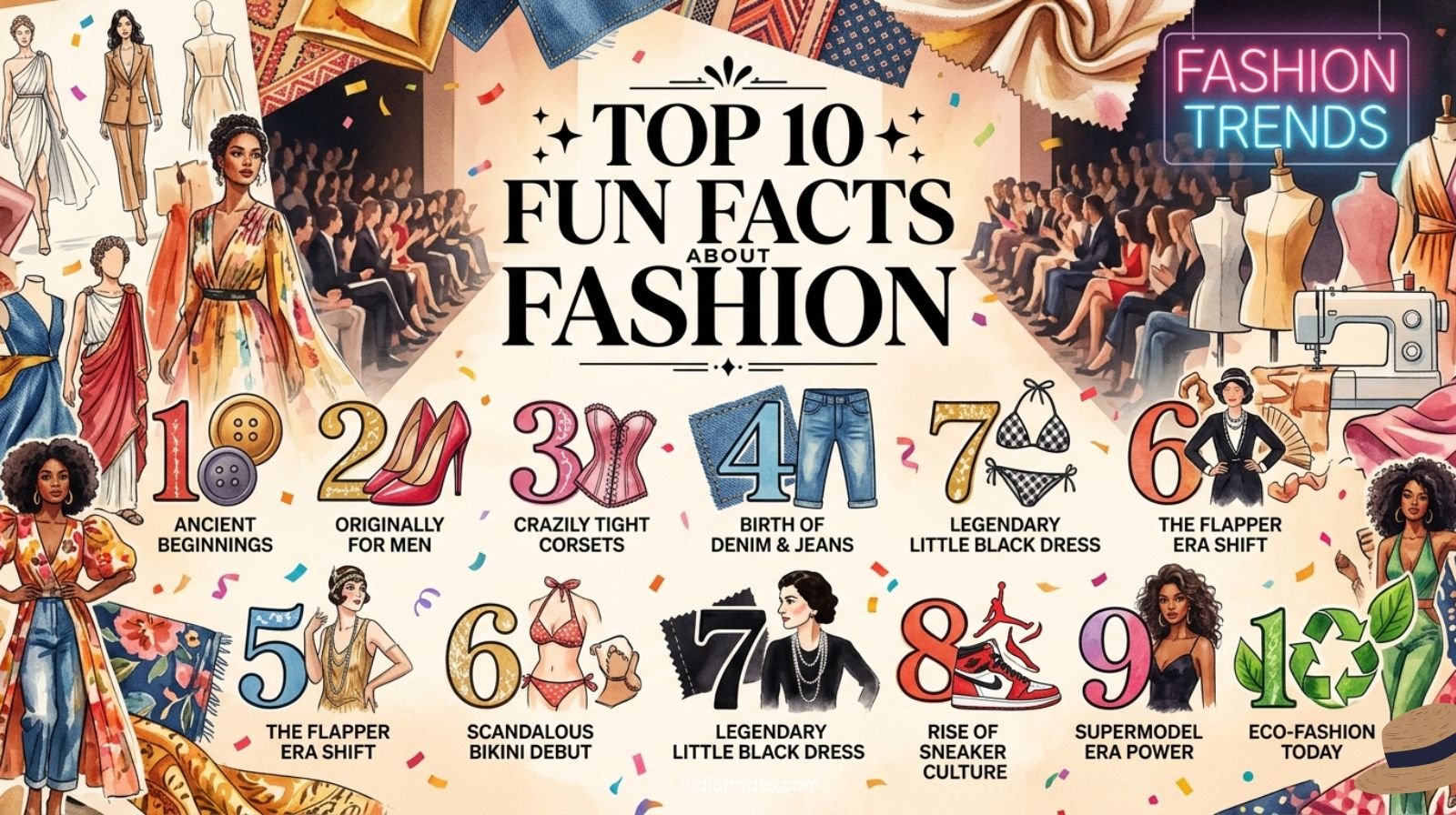
Fashion is far more than just “clothes.” It is a dynamic, living history of human ambition, social rebellion, and technological breakthroughs. In 2026, as we embrace AI-driven personal styling and sustainable textiles, the world of fashion is more exciting than ever. But to truly understand where we are going, we have to look at the bizarre, fascinating, and often accidental origins of what we wear every day.
Whether you are a Gen-Z trendsetter or a lover of vintage classics,
these stories reveal the hidden soul of your wardrobe.
From the high-stakes politics of the Renaissance to the digital runways of today, here are the top 10 fun facts about fashion that will change the way you look at your closet.
1. The “Trench” Coat Was a Victorian Innovation
While most people associate the trench coat with the mud and grit of World War I, its origins actually date back to the Victorian era.
In 1823, a chemist named Charles Macintosh patented a way to layer rubber between cotton sheets, creating the first truly waterproof fabric.
- The Evolution: It wasn’t until Thomas Burberry patented his breathable, water-repellent gabardine fabric in 1888 that the coat became a practical choice for British officers.
- Why the Name? It earned its name because it was the coat of choice for soldiers living in the trenches. Today, it remains a timeless fashion staple for its perfect blend of function and form.
2. Buttons on Sleeves: A Napoleonic Habit
Have you ever wondered why suit jackets have buttons on the sleeves that serve almost no purpose? Legend has it we owe this to Napoleon Bonaparte.
- The Story: Tired of seeing his soldiers wiping their noses on their uniform sleeves, Napoleon allegedly order buttons to be sewn onto the cuffs to make the habit uncomfortable.
- Modern Style: While we no longer use them for hygiene, these buttons remain a mark of tailoring quality, especially on “surgeon’s cuffs” where the buttons are actually functional.
3. High Heels Were Originally for Men
Long before they were a symbol of feminine elegance, high heels were a masculine tool for war. In 10th-century Persia, cavalry soldiers wore heels to help their feet
stay firm in the stirrups while shooting bows and arrows from horseback.
- Status Symbol: By the 17th century, European aristocrats like King Louis XIV wore red-soled heels to signal their elite status.
- The Shift: Women eventually adopted the trend to appear more masculine and powerful, and by the 18th century, heels transitioned into a primarily female fashion accessory.
4. The “Little Black Dress” Was a Revolutionary Act
Before the 1920s, black clothing was strictly reserve for mourning. Wearing black to a party was seen as a social “faux pas” or a bad omen. This changed forever in 1926 when Coco Chanel published a picture of a short, simple black dress in Vogue.
- The “Ford” of Fashion: Vogue called it the “Ford” of dresses because it was simple, accessible, and made for all social classes.
- Why it Matters: The LBD liberated women from restrictive corsets and colorful, expensive gowns, proving that minimalism is the ultimate form of sophistication.
5. Sneaker Culture Began with “Keds” in 1917
The word “sneaker” comes from the fact that the rubber soles were so quiet that the wearer could literally “sneak up” on someone. While rubber-soled shoes existed in the late 1800s, the first mass-marketed sneaker was the Keds in 1917.
- The Boom: It wasn’t until Marquis Converse produced the first All Star basketball shoe that sneakers became a sports icon.
- 2026 Trend: Today, sustainable sneakers made from recycled ocean plastics and mushroom leather are the new frontier of the multi-billion dollar sneakerhead market.
6. Pockets Were Once a Radical Political Issue
In the 17th and 18th centuries, men had pockets sewn into their coats,
but women had to carry “pouches” tied around their waists under their voluminous skirts.
- The Struggle: As silhouettes became slimmer in the 19th century, women lost their storage space entirely to maintain a “sleek” look.
- The Movement: The Rational Dress Society and early feminists fought for “functional pockets” as a move toward independence. Even in 2026, the cry of “It has pockets!” remains a celebrated victory in women’s fashion.
7. The World’s Oldest Leather Shoe is 5,500 Years Old
Known as the Areni-1 shoe, it was found in a cave in Armenia and dates back to 3500 BC. Surprisingly, it looks a lot like a modern “ballet flat” or a simple loafer.
- Craftsmanship: It was made from a single piece of cowhide and stuffed with grass to keep its shape.
- Takeaway: This proves that the basic human need for footwear protection hasn’t changed in over five millennia—only our materials have evolved.
8. Levi’s Jeans Were Originally for “Gold Miners”
In 1873, Levi Strauss and Jacob Davis received a patent for “waist overalls” with copper rivets at stress points. These were design for miners who needed rugged pants that wouldn’t rip during heavy labor.
- The Denim Secret: The blue color was chosen because Indigo dye was effective at hiding dirt and stains from the mines.
- Cultural Shift: It took nearly 80 years for jeans to move from “workwear” to “rebel fashion,” sparked by icons like James Dean and Marilyn Monroe.
9. Astronaut Suits are Sewn by Hand
You might imagine that space suits are built by robots in high-tech labs,
but most NASA space suits are actually hand-sewn by highly skilled seamstresses.
- The Precision: A single suit can take up to 5,000 hours to complete. Because there is no room for error in a vacuum, the stitching must be mathematically perfect.
- The Bra Connection: During the Apollo era, the suits were design and sewn by employees of Playtex (the bra company) because they were the experts in creating garments that were both flexible and airtight.
10. “Navy” is the New Black in 2026
Fashion is cyclical, and in 2026,
we are seeing a massive shift away from the harshness of jet black toward the elegance of Navy Blue.
- Why now? Navy is perceive as more approachable, calming, and versatile in a post-digital world.
- Sustainability: Many eco-friendly brands prefer navy because it requires less intensive chemical dyeing processes than deep blacks, making it a favorite for conscious consumers.
How to Use These Fashion Facts to Level Up Your Style
Knowing the history of your clothes helps you build a curated wardrobe with meaning.
- Invest in Classics: Now that you know the trench coat is 200 years old, you can buy one knowing it will never go out of style.
- Appreciate the Craft: Knowing that even astronaut suits are hand-sewn might inspire you to look closer at the stitching on your own premium denim.
- Choose Function: The history of pockets reminds us that fashion should serve our lives, not just our looks.
Conclusion: Fashion is Your Personal Story
Every time you zip up a pair of Levi’s or slip into a Little Black Dress, you are participating in a story that spans centuries.
These top 10 fun facts about fashion show that our clothes are a mix of military necessity, social rebellion, and artistic genius.
In 2026, as we move toward circular fashion and upcycled designs,
the “next big thing” is often a reimagined version of the past. Wear your clothes with pride, knowing you’re drape in history!