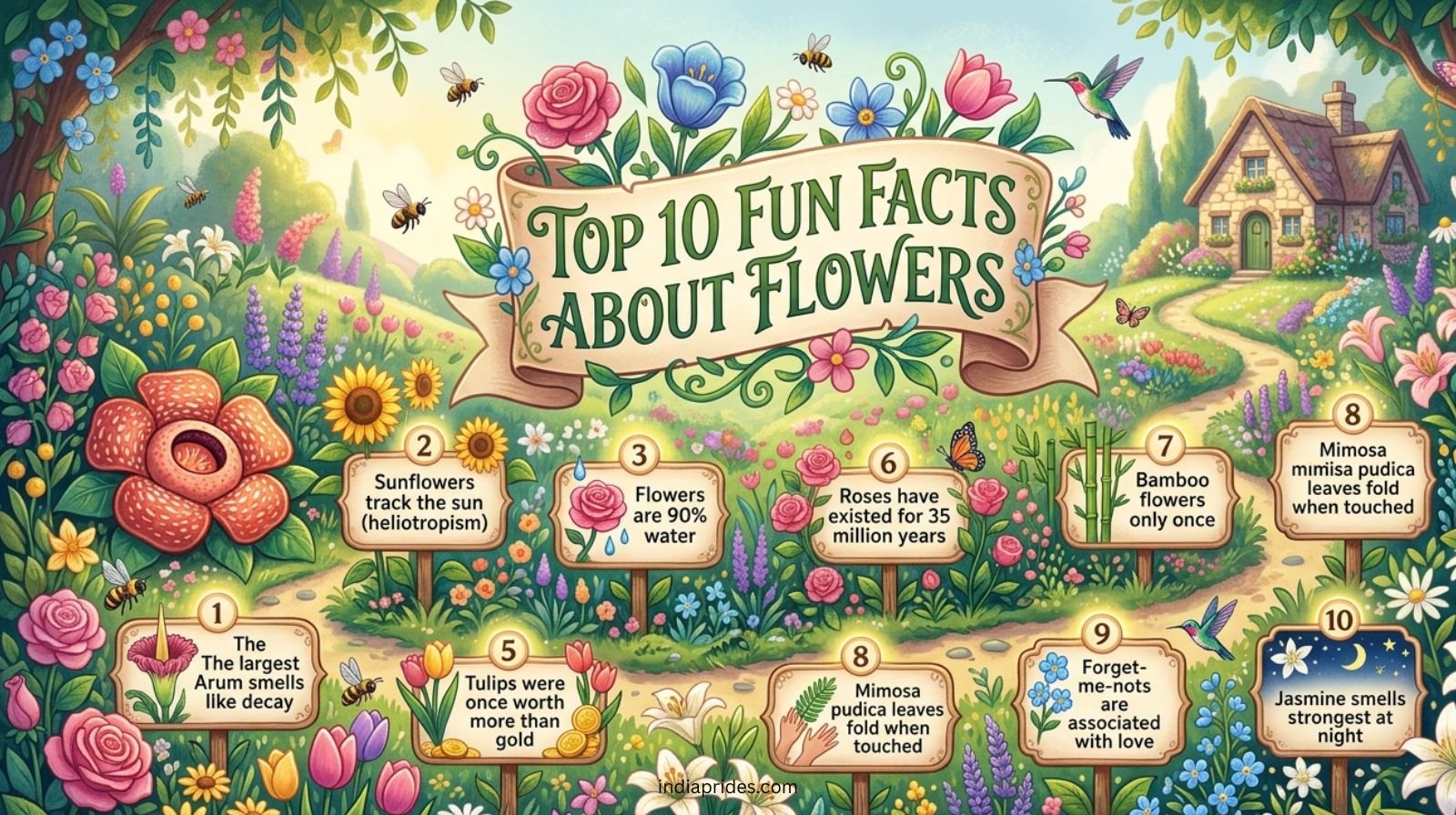
Flowers are the silent poets of our planet. They don’t just decorate our windowsills or brighten up our gardens; they are biological powerhouses with history, mystery, and a surprising amount of “personality.” Whether you are a dedicated horticulturist, a casual gardener, or someone who just loves a fresh bouquet, the world of botany holds secrets that are far more fascinating than they appear at first glance.
In this deep dive, we are going to explore the most incredible, mind-blowing facts about flowers. From blossoms that mimic the smell of decay to ancient seeds that have survived for millennia, prepare to see your favorite blooms in a whole new light.
1. The Titan Arum: The Giant That Smells Like Death
When we think of flowers, we usually imagine sweet, delicate scents like jasmine or lavender. However, the Titan Arum (Amorphophallus titanum), also known as the Corpse Flower, takes a different approach to attraction.
- Size Matters: This is one of the largest unbranched inflorescences in the world, reaching heights of over 10 feet.
- The Scent: To attract its preferred pollinators—carrion beetles and flesh flies—it emits a pungent odor of rotting meat.
- Rare Bloom: It can take seven to ten years for a single plant to bloom, and the flower only stays open for about 24 to 48 hours.
This strategy is a prime example of evolutionary adaptation. By smelling like a carcass, the Titan Arum ensures it stands out in the dense rainforests of Sumatra, where sweet smells are common but “death” is a dinner bell for its specific insect helpers.
2. Roses Are Actually Related to Your Favorite Fruits
If you’ve ever noticed a similarity between the structure of a wild rose and a slice of apple, you aren’t imagining things. Roses belong to the Rosaceae family, a massive group of plants that provides us with some of our most beloved snacks.
- Culinary Cousins: Apples, pears, cherries, plums, peaches, apricots, and even strawberries are all part of the rose family.
- Edible Petals: Most rose petals are edible and are used in everything from teas to Middle Eastern desserts.
- The Rose Hip: After a rose fades, it leaves behind a fruit called a “hip,” which is packed with more Vitamin C than most citrus fruits.
Understanding this botanical connection helps explain why many fruits have such a fragrant “floral” note when they are perfectly ripe.
3. The 3,000-Year-Old “Resurrection” Bloom
Nature has an incredible memory. In the 1990s, scientists discovered seeds of an ancient Sacred Lotus (Nelumbo nucifera) in a dried-up lake bed in China.
- Time Travelers: Using carbon dating, researchers determined the seeds were approximately 1,300 years old.
- The Miracle: When planted, these seeds actually germinated and grew into healthy, flowering plants.
- Longevity Secret: The lotus seed has an incredibly thick coat and contains a special enzyme that repairs protein damage, making it a master of biological survival.
This makes the lotus a true symbol of longevity and resilience, proving that even after centuries of dormancy, life can find a way to bloom.
4. Sunflowers: The Ultimate Solar Trackers
Sunflowers aren’t just sunny faces; they are highly efficient machines. Young sunflowers exhibit a behavior called heliotropism.
- Following the Light: During the day, the flower heads turn to face the sun as it moves from east to west.
- Nightly Reset: At night, they turn back to the east to wait for the sunrise.
- Pollinator Heat: Once the sunflower matures, it stops moving and stays facing east. Why? Because an eastward-facing flower warms up faster in the morning, which attracts up to five times more pollinators (like bees) than a cold flower.
Additionally, sunflowers are used in phytoremediation. They are excellent at soaking up toxic heavy metals and radiation from the soil, which is why they were planted in mass quantities after the Chernobyl and Fukushima disasters.
5. Saffron: The World’s Most Expensive Spice Comes from a Flower
Have you ever wondered why saffron is so expensive? It’s because it is literally the “heart” of a very specific flower.
- The Source: Saffron comes from the Crocus sativus, better known as the Saffron Crocus.
- The Labor: Each flower produces only three tiny, thread-like structures called stigmas.
- The Count: To produce just one pound of saffron, you need to harvest about 75,000 flowers by hand.
This labor-intensive process makes saffron more valuable by weight than gold. Every time you taste that earthy, floral flavor in a paella or risotto, you are tasting the concentrated essence of thousands of hand-picked blossoms.
6. Orchids: The Master Mimics
Orchids are perhaps the most diverse and “clever” family of plants on Earth. Some species have evolved to look—and smell—exactly like female insects to trick males into “mating” with them, which results in pollination.
- The Bee Orchid: This flower looks exactly like a female bumblebee resting on a petal.
- The Naked Man Orchid: These blooms look like tiny, pink human figures wearing hats.
- The Vanilla Connection: Did you know your favorite ice cream flavor comes from an orchid? The Vanilla planifolia is the only orchid that produces edible fruit (the vanilla bean).
Orchids can be found on every continent except Antarctica, showcasing a level of biodiversity that is almost unparalleled in the plant kingdom.
7. Tulips Were Once Worth More Than Gold
In the 1630s, the Netherlands was swept up in “Tulip Mania.” This was essentially the world’s first major speculative economic bubble.
- Luxury Status: Tulips were a newly introduced luxury item, and their vibrant, “broken” colors (actually caused by a virus) made them highly coveted.
- The Peak: At the height of the craze, a single tulip bulb could cost more than a high-end house in Amsterdam.
- The Crash: Eventually, the market collapsed, leaving many investors with nothing but a few handfuls of onions-like bulbs.
Today, the tulip remains a symbol of the Netherlands, but fortunately, they are now much more affordable for the average gardening enthusiast.
8. Some Flowers Bloom Only at Night
While most flowers open to greet the morning sun, a secret world of nocturnal blooms exists for those who stay up late.
- Moonflowers: These large, white flowers open rapidly at dusk and glow under the moonlight.
- Queen of the Night: This rare cactus flower blooms only once a year, for one single night, before wilting at dawn.
- Moth Pollinators: These flowers are usually white or pale yellow to be visible in the dark and emit heavy, sweet scents to guide nocturnal pollinators like moths and bats.
The Night-Blooming Cereus is a favorite among plant collectors for its dramatic, short-lived performance that reminds us of the fleeting beauty of nature.
9. Broccoli and Cauliflower Are Actually Flowers
If you’ve ever struggled to get your kids to eat their greens, you can tell them they aren’t eating vegetables—they’re eating flower buds.
- The Harvest: Broccoli, cauliflower, and artichokes are all harvested before their flower buds have a chance to open.
- The Bloom: If left in the field, a head of broccoli would eventually erupt into a sea of small, yellow blossoms.
- Edible Botany: This reminds us that our food systems are deeply intertwined with the reproductive cycles of plants.
Next time you steam some broccoli, look closely at the “florets”—you’re looking at thousands of tiny, un-bloomed flowers.
10. The Gas Plant: A Flower That Can Catch Fire
The Dictamnus albus, commonly known as the Gas Plant or “Burning Bush,” produces a lemon-scented oil that is highly flammable.
- A Real Spark: On hot, still summer nights, the volatile oils can build up around the flower clusters.
- The Experiment: If you hold a match near the flower, the oil can ignite, creating a brief, blue flame that doesn’t actually harm the plant itself.
- The Scent: While it sounds dangerous, gardeners love it for its beautiful white and pink spikes and its refreshing citrus fragrance.
This unique chemical defense or byproduct of its metabolism is one of the coolest “parlor tricks” in the natural world.
Conclusion: Why Flowers Matter
Flowers are so much more than just a visual treat. They are essential for our ecosystem, providing food for insects, medicine for humans, and a vital link in the chain of life. Whether it’s the resilience of a lotus seed or the mimicry of an orchid, flowers teach us about the complexity and brilliance of evolution.
The next time you walk past a garden or receive a bouquet, take a moment to appreciate the millions of years of history and the incredible “intelligence” contained within those petals. The world of floristry and botany is a never-ending story of wonder.