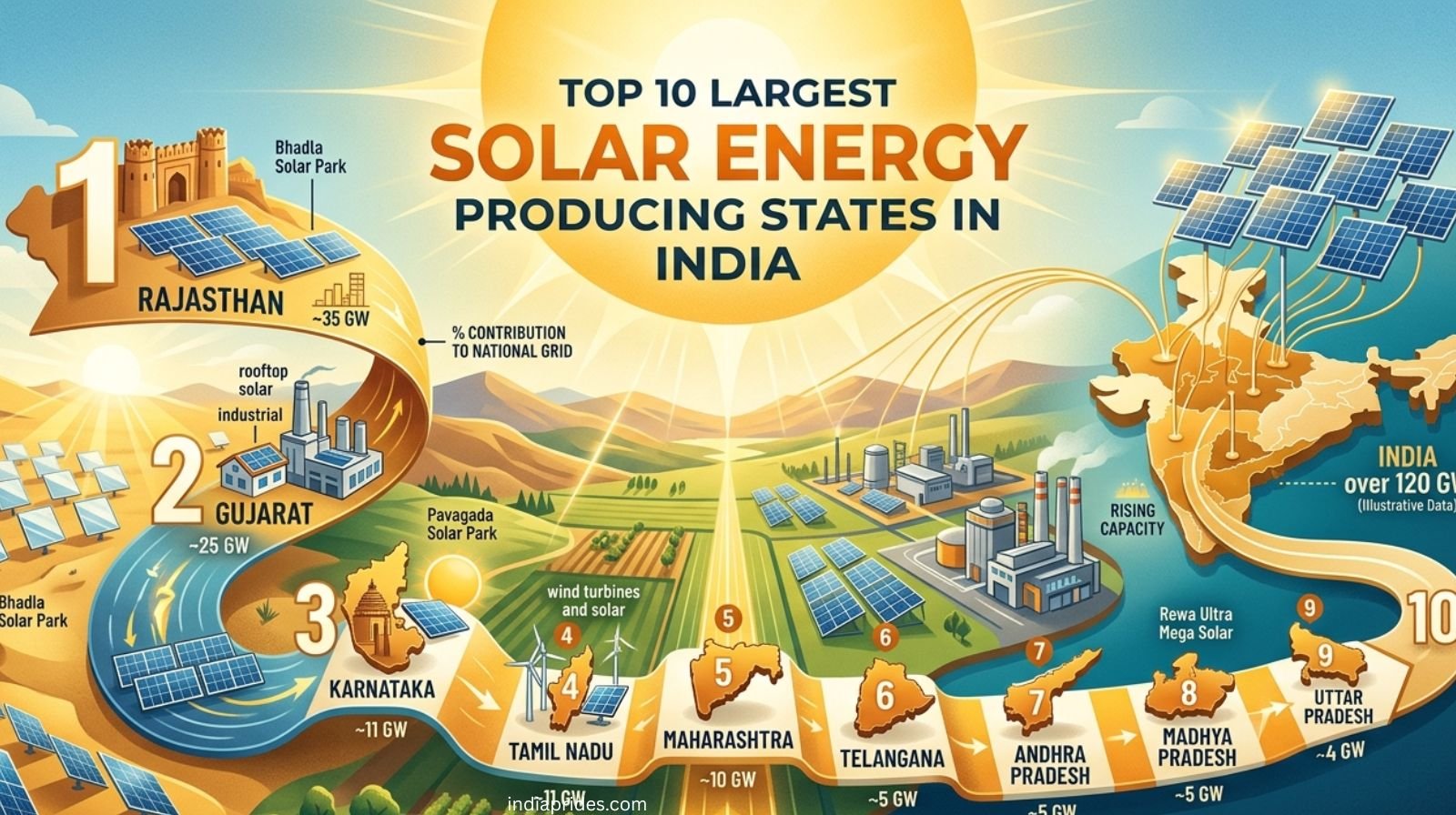
As of 2026, India has officially cemented its position as a global green energy superpower. With a staggering total solar capacity exceeding 150 GW, the nation has not only met its Paris Agreement targets years ahead of schedule but has transformed its vast landscapes into “temples of clean energy.” From the scorching sands of the Thar Desert to the lush plains of the Deccan, solar panels are now a permanent fixture of the Indian horizon.
The shift toward renewable energy is no longer just an environmental necessity; it is an economic engine. In this comprehensive breakdown, we are exploring the top 10 largest solar energy producing states in India. These states are the pioneers of the “Surya Shakti” movement, balancing massive utility-scale parks with innovative rooftop schemes. If you want to know which region holds the crown as the largest solar energy producing state in India, you are in the right place.
1. Rajasthan: The Sun King of India
Rajasthan continues to hold its throne as the absolute largest solar energy producing state in India. With over 28.7 GW of installed capacity, the state alone accounts for a massive chunk of India’s solar footprint.
- Bhadla Solar Park: Located in Jodhpur, this is the world’s largest operational solar park, covering 14,000 acres with a capacity of 2,245 MW.
- Ideal Irradiation: The Thar Desert provides some of the highest solar irradiation levels in the world, making it a natural goldmine for energy.
- Economic Impact: Large-scale projects have turned “wastelands” into high-value zones, providing thousands of local jobs in maintenance and robotics.
- 2026 Milestone: The state has moved beyond utility parks to focus on solar-wind hybrid projects to ensure a stable 24/7 power supply.
2. Gujarat: The Hybrid Powerhouse
Gujarat has seen a meteoric rise, securing the second spot with a capacity of approximately 19.4 GW. The state is currently building the world’s largest renewable energy park in Khavda.
- Khavda Project: This massive hybrid park in the Rann of Kutch is planned to reach 30 GW (solar + wind combined), a feat of engineering visible from space.
- Rooftop Leadership: Gujarat remains the #1 state for rooftop solar installations, with over 3,800 MW generated from residential and commercial roofs.
- Canal Solar: The state pioneered “Canal-top” solar projects, which generate electricity while reducing water evaporation from irrigation canals.
3. Karnataka: The Innovation Hub
Karnataka was one of the first states to cross the 5 GW mark and currently maintains a robust 9.6 GW of solar production.
- Pavagada Solar Park: Also known as Shakti Sthala, this 2,050 MW park is famous for its “land-lease” model, where farmers retain ownership and receive rent, ensuring rural prosperity.
- Technology Adoption: The state integrates advanced AI-driven grid management to balance its high mix of solar and wind energy.
- Future Expansion: The Karnataka government recently announced plans to add another 3 GW to its existing parks.
4. Maharashtra: The Industrial Green Giant
Maharashtra has overtaken several states to claim the fourth position with over 11.1 GW of capacity. Its focus has been on “decentralized” energy for its massive industrial clusters.
- Solar Villages: Manyachiwadi in Satara district recently became Maharashtra’s first 100% solarized village.
- Agri-Solar: The state is a leader in PM-KUSUM implementation, providing solar pumps to farmers to reduce reliance on the traditional grid.
- Open Access: Maharashtra leads in “open access” solar, allowing private corporations to buy solar power directly from developers.
5. Tamil Nadu: The Integrated Leader
Tamil Nadu remains a heavyweight in the renewable sector with 10.3 GW of solar capacity. It is unique for its highly balanced mix of wind and solar.
- Kamuthi Solar Plant: At one point the world’s largest single-location plant, Kamuthi continues to be a marvel of rapid execution (built in just 8 months).
- Distributed Energy: The state is focusing on district-level solar parks to reduce transmission losses and empower local municipalities.
- Grid Stability: Due to its high wind capacity, Tamil Nadu is a leader in managing the “intermittency” of renewable energy.
6. Andhra Pradesh: The High-Speed Executor
With 5.4 GW of capacity, Andhra Pradesh is known for building ultra-mega solar parks in record time.
- Kurnool Ultra Mega Solar Park: This 1,000 MW park was completed in just two years, showcasing the state’s ease-of-doing-business in the energy sector.
- NP Kunta Park: Another massive installation in Anantapur that supports the state’s industrial corridors.
- Integrated Storage: The state is currently pioneering some of India’s largest Pumped Hydro + Solar storage projects.
7. Madhya Pradesh: The Heart of Solar
Madhya Pradesh has made significant strides, reaching a capacity of 5.1 GW. It is home to some of the most iconic projects in Central India.
- Rewa Solar Project: This 750 MW project was the first in India to achieve “grid parity” (costing less than coal) and famously powers the Delhi Metro.
- Floating Solar: MP is home to one of the world’s largest floating solar projects on the Omkareshwar Reservoir, saving land and reducing water evaporation.
8. Telangana: The Urban Solar Pioneer
Telangana maintains a strong presence with 4.8 GW of solar energy. The state focuses heavily on integrating solar into its rapidly growing IT hubs.
- Ramagundam Floating Solar: A 100 MW floating plant that serves as a model for utilizing water bodies for energy production.
- Policy Support: The state’s “Single Window Clearance” has attracted massive private investment from global solar developers.
9. Uttar Pradesh: The Sleeping Giant Awakes
Uttar Pradesh is the fastest-climbing state on this list, currently at 3.3 GW but with the largest pipeline of upcoming projects in North India.
- Bundelkhand Solar Circuit: Massive tracts of land in the Bundelkhand region are being converted into solar hubs to drive regional development.
- Solar City Ayodhya: The government is transforming Ayodhya into a “model solar city” with solar streetlights, ferries, and rooftops.
10. Haryana: Small State, Big Ambition
Haryana rounds out the top 10 with 2.1 GW. Despite its limited land area, it has maximized every square inch for solar production.
- Rooftop & Industrial: Because of land scarcity, Haryana has become a leader in rooftop solar for its massive industrial zones in Gurgaon and Faridabad.
- Canal-Top Projects: Following Gujarat’s lead, Haryana is utilizing its extensive canal network for solar installations.
Why India’s Solar Growth is Unstoppable in 2026
What makes a state a largest solar energy producing state in India? It’s not just the sun; it’s the strategy.
- Declining Costs: Solar energy in India is now nearly 20-30% cheaper than coal-based power in most states.
- Energy Storage: The rise of Battery Energy Storage Systems (BESS) has solved the “sun doesn’t shine at night” problem.
- Government Schemes: Initiatives like PM Surya Ghar (giving 300 units of free power to 1 crore households) have democratized energy.
- Manufacturing PLI: India now makes its own high-efficiency solar modules, reducing dependence on imports.
Conclusion
India’s journey toward 500 GW of non-fossil fuel capacity by 2030 is being written by these 10 states. While Rajasthan remains the largest solar energy producing state in India, the competition from Gujarat and Maharashtra is healthy for the nation’s energy security. Every watt of solar power generated is a step toward a cleaner, more prosperous, and truly “Atmanirbhar” India.