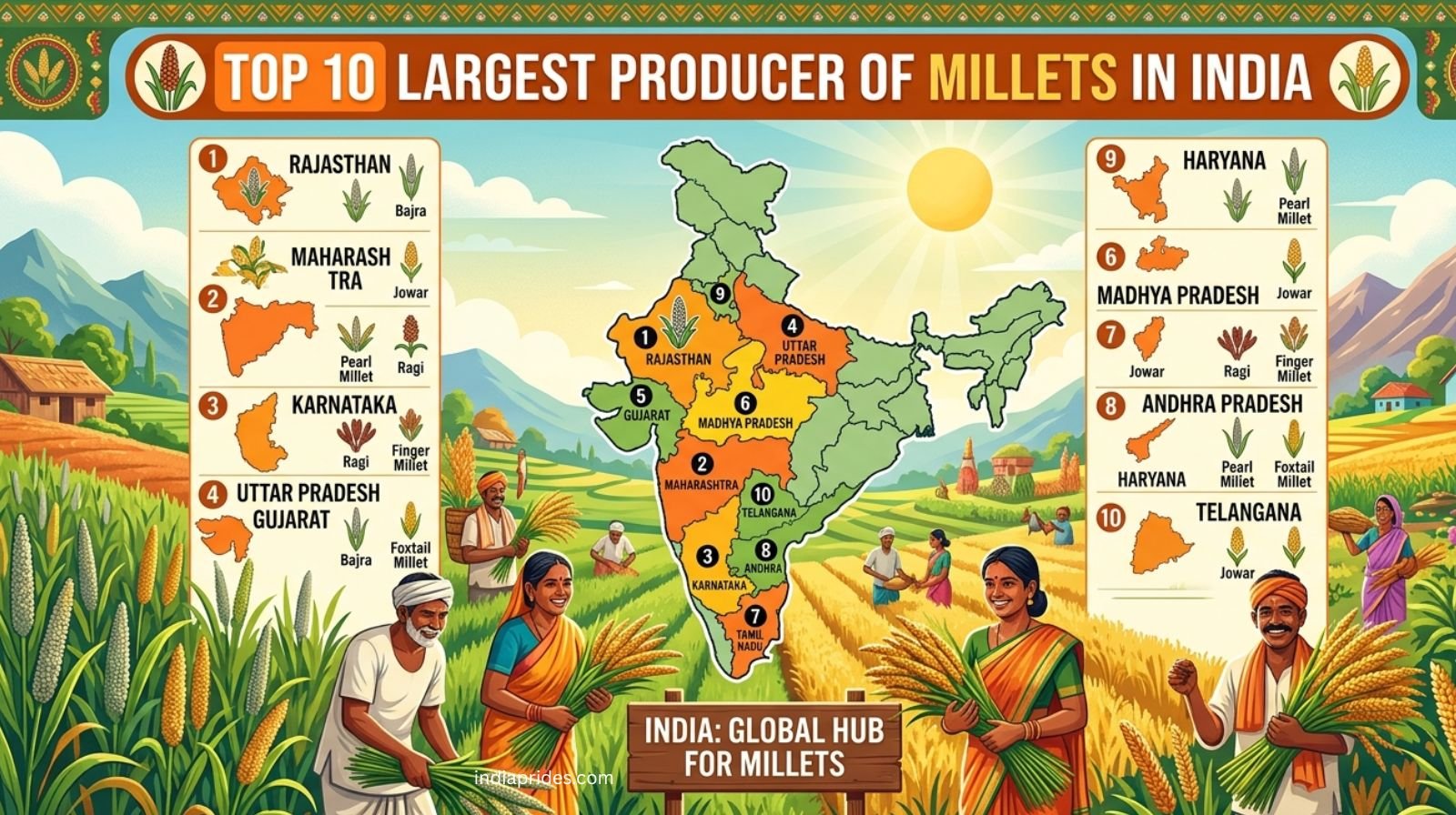
As of 2026, the world has officially embraced the “Millet Movement.” Once known as the “forgotten grains,” millets have made a spectacular comeback as the ultimate climate-resilient superfood. India, leading this global resurgence, accounts for nearly 40% of the world’s millet production, reaching a record-breaking 18.59 million tonnes in the 2024-25 agricultural cycle.
From the gluten-free Ragi in the south to the drought-defying Bajra in the north, millets are the backbone of India’s nutritional security and sustainable farming. Whether you are a health-conscious foodie or an agri-tech enthusiast, understanding the geography of these ancient grains is vital. In this detailed guide, we reveal the top 10 largest producer of millets in India, highlighting the states that are turning “drylands into goldmines.”
1. Rajasthan: The Millet King of the Thar
When it comes to being the largest producer of millets in India, Rajasthan sits firmly on the throne. The state’s arid landscape isn’t a limitation; it is a natural advantage for hardy grains.
- Pearl Millet Dominance: Rajasthan contributes over 28% to 30% of India’s total millet output, primarily through Bajra.
- Massive Output: The state recorded a staggering 53.96 lakh tonnes of millet production in the latest 2024-25 estimates.
- Low Water Requirement: These crops thrive in the sandy soils of Bikaner, Jodhpur, and Barmer where other cereals fail.
- Cultural Staple: Bajre ki Roti and Khichdi are not just foods here; they are a lifestyle that has fueled generations.
2. Maharashtra: The Sorghum Powerhouse
Maharashtra is a titan in the millet sector, particularly leading the nation in Jowar (Sorghum) production.
- Second in Rank: Consistently holding the position of the second-largest producer of millets in India, Maharashtra produced 25.58 lakh tonnes.
- Nachni and Jowar: While Jowar is the king of the Marathwada region, the Konkan belt is famous for Nachni (Finger Millet).
- Innovation: The state is a hub for millet-based startups, converting raw grains into high-value snacks like millet puffs and cookies.
- Climate Resilience: Farmers here have mastered “Smart Agriculture,” utilizing millets to combat the frequent droughts in the Vidarbha region.
3. Karnataka: The Ragi Champion
If Rajasthan owns Bajra, Karnataka owns Ragi (Finger Millet). The state is the spiritual and agricultural home of this calcium-rich grain.
- Third Largest Producer: Karnataka contributes roughly 18% of the national output, with a production of 22.79 lakh tonnes.
- Ragi Mudde Culture: In districts like Mandya and Tumakuru, Ragi is a primary dietary staple, praised for its low glycemic index.
- Smart Farming: Karnataka was one of the first states to launch a dedicated “Millet Mission,” providing price support and advanced processing machinery to farmers.
- Nutritional Power: The state’s focus on Finger Millet has made it a leader in the “Health Food” segment of the Indian market.
4. Uttar Pradesh: The Northern Contributor
Uttar Pradesh, with its fertile Gangetic plains, has diversified its massive agricultural output to include significant millet cultivation.
- High Volume: The state accounts for roughly 12% of India’s millet production, reaching 21.58 lakh tonnes.
- Pearl Millet Focus: Western UP is a major belt for Bajra, which is used extensively for both human consumption and cattle fodder.
- Inter-cropping: Farmers in UP often grow millets alongside pulses, creating a sustainable and nutrient-rich farming ecosystem.
5. Gujarat: The Productivity Leader
Gujarat may not have the largest acreage, but it is often the largest producer of millets in India when measured by yield per hectare.
- Efficient Farming: With a production of 13.48 lakh tonnes, Gujarat’s farmers use precision agriculture to get more out of every acre.
- Coastal Success: Districts like Banaskantha and Kutch are the primary hubs for high-quality Bajra.
- Industrial Integration: The state’s robust dairy industry uses millet stalks as premium fodder, creating a highly profitable livestock-millet cycle.
6. Haryana: The Modern Agri-State
Haryana has transitioned from the Green Revolution staples of wheat and rice to become a significant millet producer.
- Production Stats: Haryana produced 12.62 lakh tonnes of millets, primarily focusing on Bajra.
- High-Yield Varieties: The state utilizes the latest hybrid seeds developed by agri-research centers to ensure pest-resistant harvests.
- Millet Snacks: Haryana is a key supplier to the FMCG companies in the Delhi-NCR region that produce millet-based breakfast cereals.
7. Madhya Pradesh: The Tribal Superfood Hub
Madhya Pradesh is the heart of India’s minor millet production, including Kodo and Kutki.
- Unique Varieties: While others focus on Bajra, MP is the largest producer of millets in India for Kodo (Paspalum scrobiculatum) and Little Millet.
- Production Figure: The state contributed 11.46 lakh tonnes to the national pool.
- Tribal Empowerment: Much of the cultivation is done by tribal communities in Dindori and Mandla, who are now receiving global recognition for their organic farming practices.
8. Tamil Nadu: The Traditional Technologist
Tamil Nadu has a long-standing tradition of millet consumption, which has been revitalized by modern health trends.
- Output: The state produced 7.66 lakh tonnes of various millets.
- Multi-Millet Focus: Tamil Nadu grows a wide variety, including Barnyard (Sanwa), Foxtail (Kangni), and Proso (Chena) millets.
- Value Addition: Coimbatore and Chennai are major centers for the processing of millet-based “ready-to-eat” traditional dishes like Idli and Dosa mixes.
9. Andhra Pradesh: The Yield Specialist
Andhra Pradesh ranks among the best in the country for its technological approach to millet farming.
- Production: With 4.18 lakh tonnes, the state is focusing on quality over quantity.
- Highest Productivity: Andhra Pradesh often records the highest yield per hectare in the country, thanks to advanced soil health management.
- Rayalaseema Belt: The drier regions of the state are being transformed into specialized “Millet Clusters.”
10. Telangana: The Rising Contender
Telangana completes our top 10 list, with a growing emphasis on shifting away from water-intensive paddy to climate-smart millets.
- Policy Support: The state government’s push for crop diversification has seen a steady increase in Jowar and Ragi cultivation.
- Seed Innovation: Being the seed capital of India, Telangana provides high-quality millet seeds to the rest of the country.
The 2026 Shift: Why Millets are the Future
In 2026, the status of being the largest producer of millets in India is a badge of sustainability.
- Climate Resilience: Millets require 70% less water than rice and can grow in temperatures up to 45°C.
- Nutritional Density: They are packed with Iron, Calcium, and Magnesium, making them a vital tool in fighting “hidden hunger” (micronutrient deficiency).
- Carbon Footprint: Millets have a significantly lower carbon footprint compared to wheat and rice, making them the preferred choice for eco-conscious consumers.
Conclusion
India’s journey to becoming the world’s millet hub is being led by these 10 incredible states. While Rajasthan remains the undisputed largest producer of millets in India, the diversity of grains from Karnataka and the technological precision of Andhra Pradesh show that the entire country is committed to this “Superfood Revolution.” By choosing millets, we aren’t just eating better; we are supporting a farming system that respects the planet.