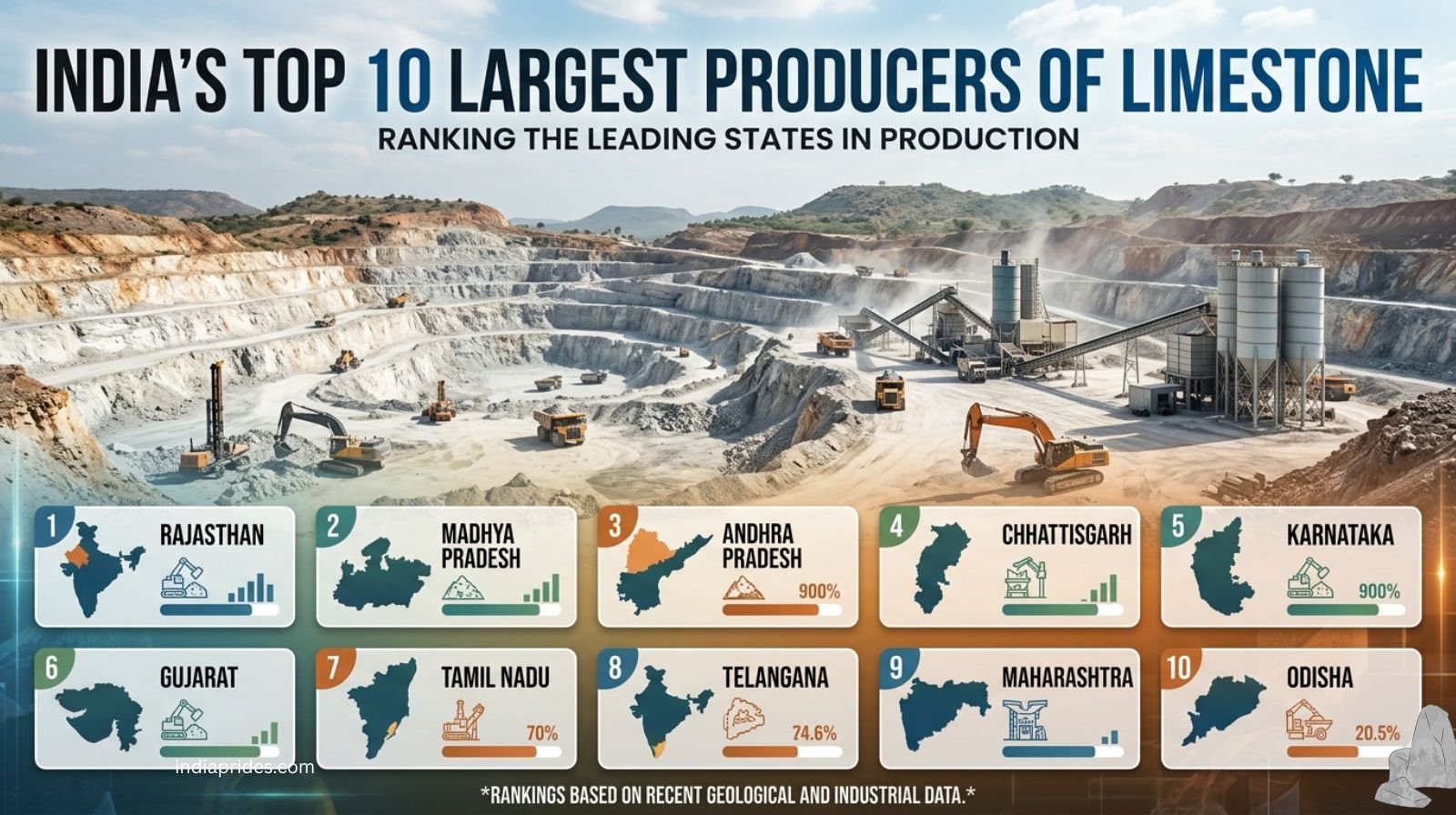
In the world of industrial minerals, limestone is often referred to as the “silent architect.” From the massive skyscrapers defining our urban skylines to the glass in our windows and the steel in our bridges, limestone is the foundational ingredient. As of 2026, India has solidified its position as one of the world’s leading consumers and producers of this versatile sedimentary rock, driven primarily by a booming cement industry and massive infrastructure projects like Smart Cities and Expressways.
The demand for limestone is intrinsically link to the pulse of the nation’s growth. Every ton of cement requires approximately 1.1 tons of limestone, making it the most critical raw material for the construction sector. In this comprehensive guide, we profile the top 10 largest producer of limestone in India, highlighting the states that serve as the mineral backbone of our rising economy.
1. Rajasthan: The Reigning Monarch
Rajasthan continues to be the undisputed largest producer of limestone in India. With its vast desert landscapes hiding massive geological treasures, the state is a powerhouse of non-metallic minerals.
- Production Share: Rajasthan accounts for nearly 22% to 24% of India’s total limestone production.
- Key Districts: Jaisalmer, Nagaur, Chittorgarh, and Jodhpur are the primary hubs.
- Steel-Grade Superiority: The Jaisalmer region is world-renown for its low-silica limestone, which is the preferred choice for India’s top steel manufacturers like SAIL and TISCO.
- Auction Success: As of 2026, Rajasthan leads the nation in successful mineral block auctions, ensuring a steady pipeline of raw materials for the next decade.
2. Madhya Pradesh: The Heart of the Mineral Belt
Madhya Pradesh holds the second spot, offering high-quality cement-grade deposits that fuel the industrial corridors of Central India.
- Strategic Growth: MP contributes roughly 13% to 14% of the national output.
- The Satna Star: Satna is often call the “Cement City” of India due to its immense limestone reserves and high density of cement plants.
- Varieties: The state is famous for the Rohtas and Nagod varieties, which are prize for their hardness and chemical purity.
- Industrial Synergy: Most of the limestone here is consumed by local giants like UltraTech and Ambuja Cements.
3. Andhra Pradesh: The Southern Powerhouse
Andhra Pradesh has long been a giant in the mineral sector, particularly for its contribution to the infrastructure of South India.
- Volume of Output: The state produces approximately 12% to 13% of India’s limestone.
- Rayalaseema Belt: Districts like Kurnool, Anantapur, and Kadapa are the primary contributors.
- Cement Backbone: The limestone found here is the primary reason why Andhra Pradesh is one of the largest cement-producing states in the country.
- Tadpatri and Yerraguntla: These specific mining zones are legendary for their high-grade Narji limestone.
4. Chhattisgarh: The Rising Industrial Giant
Chhattisgarh has transformed from a primarily coal-rich state into a diversified mineral leader, securing its place as a major largest producer of limestone in India.
- National Share: The state contributes nearly 11% to the national limestone pool.
- Steel and Cement: While most limestone goes to cement, the deposits in Raipur and Durg are also critical for the state’s massive iron and steel sector.
- Mining Efficiency: Chhattisgarh has been a pioneer in adopting sustainable mining practices, reducing the environmental footprint of limestone extraction.
5. Karnataka: The Resource King
While it ranks fifth in current production, Karnataka holds the largest limestone reserves in India, positioning it for future dominance.
- Production Output: Karnataka produces about 8% to 9% of India’s limestone.
- Vast Reserves: The state holds nearly 25% to 28% of the country’s total limestone resources.
- Quality Hubs: Gulbarga (Kalaburagi) and Bagalkot are the most active mining regions, known for high-quality flux and cement-grade stone.
6. Gujarat: The Coastal Contributor
Gujarat’s limestone production is unique because it is strategically located near major ports, facilitating both domestic sea transport and international trade.
- Coastal Clusters: Districts like Porbandar and Junagadh produce some of the best quality limestone in the West.
- Marl Production: Gujarat is also the only significant producer of Marl, a specialized calcareous rock used in cement.
- Chemical Industry: Beyond construction, Gujarat’s limestone is a vital input for its massive Soda Ash and chemical manufacturing sectors.
7. Tamil Nadu: The Precision Miner
Tamil Nadu has a long history of utilizing its limestone for both industrial and architectural purposes.
- Regional Strength: The state accounts for roughly 7% to 8% of the national production.
- Key Districts: Ariyallur, Tiruchirappalli, and Salem are the primary mining centers.
- Value Addition: Tamil Nadu is a leader in producing fine-grade lime and specialized chemicals derived from limestone.
8. Telangana: The Modern Miner
Since its formation, Telangana has aggressively mapped its mineral wealth, emerging as a significant largest producer of limestone in India.
- Economic Impact: The state contributes about 7% to the total production.
- Key Zones: Nalgonda and Adilabad are the heart of the state’s limestone industry.
- Infrastructure Push: The state uses its limestone reserves to power its own massive irrigation and housing projects.
9. Meghalaya: The Eastern Frontier
Meghalaya is the leading producer in Northeast India, boasting high-grade limestone that is often exported to neighboring countries.
- Quality over Quantity: While the volume is lower than in the desert states, Meghalaya’s limestone is among the purest in the world.
- Industrial Potential: The state supplies the entire Northeast with the raw materials needed for infrastructure development.
10. Himachal Pradesh: The Mountain Reservoir
Despite the challenges of hilly terrain, Himachal Pradesh contributes significantly to the Northern India construction market.
- High-Grade Deposits: The state produces nearly 2% to 3% of the national output.
- Solan and Bilaspur: These districts are the primary hubs, feeding the cement plants that supply Punjab, Haryana, and Chandigarh.
The Science of Limestone: Why It Matters
What makes a state a largest producer of limestone in India? It is a combination of geology and chemistry.
- Composition: Limestone is primarily composed of calcium carbonate ($CaCO_3$).
- Grades: * Cement Grade: Used in Portland cement.
- BF Grade (Blast Furnace): Used as a flux in steel making.
- Chemical Grade: Used in paper, sugar, and glass manufacturing.
- Formation: Most Indian limestone was formed millions of years ago from the remains of marine organisms in ancient shallow seas.
The 2026 Trend: Green Mining and Innovation
In 2026, the status of being the largest producer of limestone in India comes with a commitment to the environment.
- Reclamation: Many mines are now being converted into biodiversity parks or water reservoirs once extraction is complete.
- Carbon Capture: Scientists are exploring ways to use limestone mines for carbon sequestration to offset industrial emissions.
- Digital Mining: AI and drones are now used to map deposits with centimeter-level accuracy, reducing waste.
Conclusion
From the rugged hills of Rajasthan to the fertile plains of Andhra Pradesh, limestone is the fuel for India’s “Build” story. While Rajasthan remains the reigning largest producer of limestone in India, the collective output of these 10 states ensures that the nation’s dream of modern infrastructure remains on solid ground. By understanding the geography of our minerals, we appreciate the true scale of the work going into building the India of tomorrow.