In the modern era, Google is more than just a search engine; it is a verb, a librarian, a navigator, and a primary gateway to the collective knowledge of humanity. From its humble beginnings in a California garage to becoming a trillion-dollar behemoth under the umbrella of Alphabet Inc., Google has woven itself into the fabric of our daily existence.
As we navigate through 2026, the company continues to push the boundaries of Artificial Intelligence, quantum computing, and sustainable technology. But behind the sophisticated algorithms and sleek interfaces lies a history filled with quirky traditions, accidental names, and bizarre internal policies.
Whether you are a tech enthusiast or a casual surfer, these Top 10 Google fun facts offer a fascinating glimpse into the culture of the world’s most influential tech giant.
1. The Accidental Name: A “Googol” Gone Wrong
The word “Google” is now a household name, but it was actually the result of a spelling mistake. Founders Larry Page and Sergey Brin originally intended to name the search engine “Googol.”
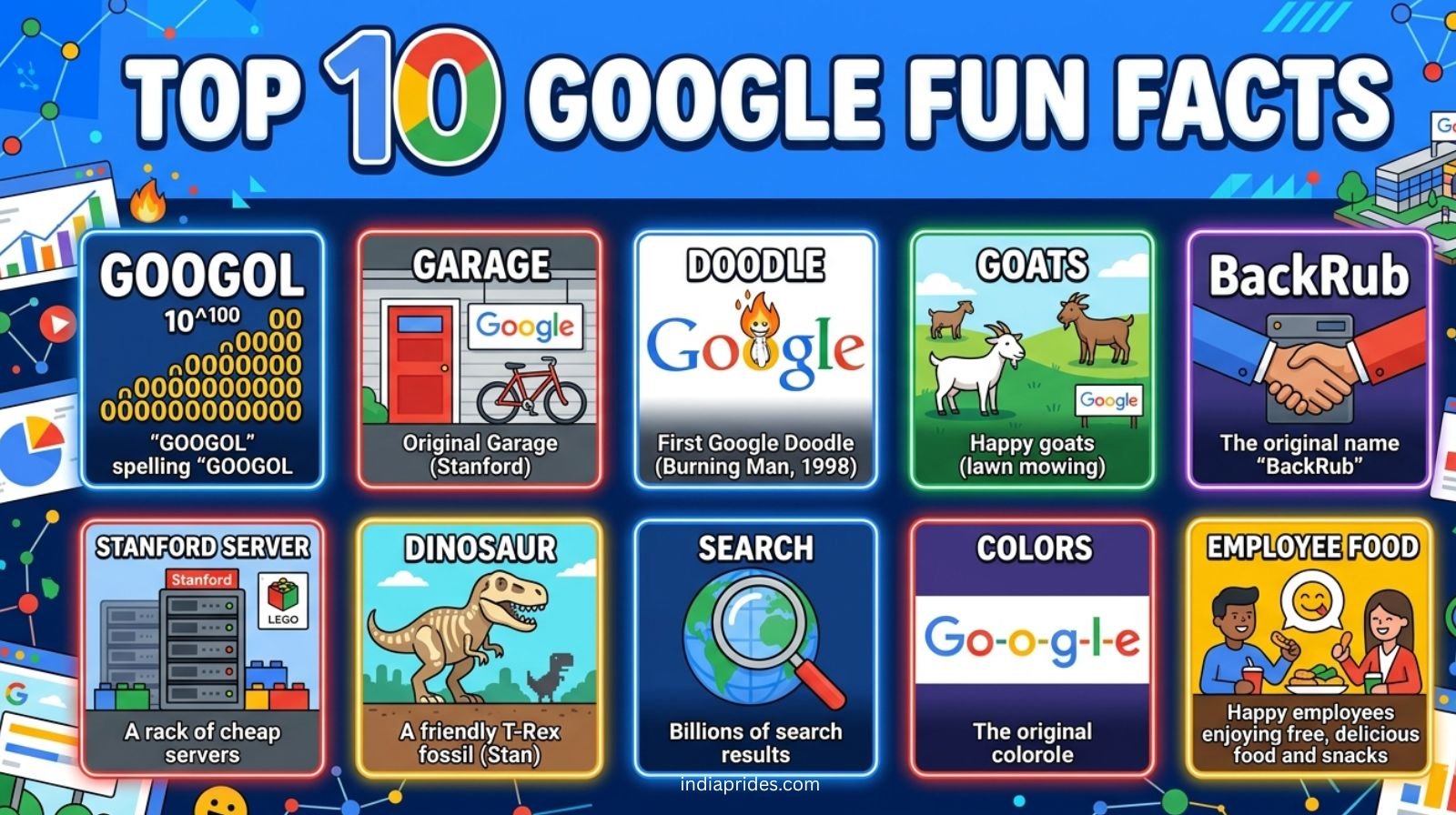
A googol is a mathematical term representing the number 1 followed by 100 zeros. It was meant to symbolize the company’s mission to organize an infinite amount of information on the web. However, when checking if the domain name was available, a graduate student accidentally typed “google.com” instead of “googol.com.” The founders liked the misspelling better, and the rest is history.
- Original Name: Before even “Googol,” the project was called “BackRub” because the technology analyzed “backlinks” to determine the importance of a website.
- The First Office: The domain was registered in 1800 square feet of garage space belonging to Susan Wojcicki, who later became the CEO of YouTube.
2. The “I’m Feeling Lucky” Button Costs Millions
Have you ever wondered why the “I’m Feeling Lucky” button still exists? This feature bypasses all search results and takes you directly to the top-ranked page for your query.
While it is a nostalgic part of the Google homepage, it is technically a financial disaster. Because the button skips the search results page, it also skips all the Google Ads that would have been display.
- The Cost: Estimates suggest that this single button costs Google roughly $110 million per year in lost advertising revenue.
- Why Keep It? Google executives have stated that it serves as a reminder that there are real people behind the search engine and that it’s not just a “corporate machine.”
3. Google’s First Storage Was Made of LEGOs
In 1996, when Larry and Sergey were testing the PageRank algorithm at Stanford University, they needed a massive amount of storage to house their data. At the time, 4GB hard drives were the cutting edge.
To create a storage primary of 40GB, they used ten 4GB drives. To hold them all together in a cost-effective and expandable way, they built a cabinet out of LEGO bricks.
- The Colors: Many believe the primary colors of the Google Logo (Blue, Red, Yellow, and Green) were inspired by those original LEGO bricks use in their first server.
- The Artifact: You can actually see this original LEGO server on display at the Stanford University museum.
4. The “Goats” of Google HQ
Google is famous for its environmentally friendly initiatives, but one of their most popular programs is decidedly “low-tech.” Instead of using loud, gas-gulping lawnmowers to trim the grass at their Mountain View headquarters (Googleplex), they hire goats.
A local herder brings a flock of approximately 200 goats to the campus for a week at a time.
- The Benefits: The goats are much quieter than mowers, they don’t produce carbon emissions, and they “fertilize” the soil while they work.
- The Experience: Employees find the presence of the goats calming, making it a win-win for workplace wellness and the environment.
5. The T-Rex and the “Dino Run” Game
If your internet goes down while using Chrome, you are greet by a pixelate Tyrannosaurus Rex. This isn’t just a cute graphic; it’s a fully playable game known as “Dino Run.”
The game was add in 2014 as a way to entertain frustrate users while their connection was “prehistoric.”
- Fun Fact: If you are a truly dedicate gamer, it would take you roughly 17 million years of continuous play to finish the game—a nod to how long the T-Rex existed on Earth.
- How to Play: Simply hit the spacebar on your desktop or tap the screen on your mobile device when the “No Internet” screen appears.
6. Google Owns Common Typos of Its Own Name
Google is obsessive about its Brand Protection. To ensure that users always end up on their site, the company owns a massive list of domains that are common misspellings of “Google.”
If you type Gooogle.com, Gogle.com, or even 466453.com (which is how you would spell “Google” on a traditional telephone keypad), you will be automatically redirect to the main search engine.
- The Portfolio: Google owns thousands of domains to prevent “cybersquatting” and to maintain their Global Search Dominance.
7. The “Noogler” and “Doogler” Culture
Google has a unique internal language for its employees. A new employee is officially called a “Noogler” (pronounced New-gler). On their first Friday, Nooglers are required to wear a colorful propeller hat.
- Dooglers: Google is a very dog-friendly company. Employees are encouraged to bring their pets to work, and these canine companions are officially called “Dooglers.”
- Greyglers: This term refers to Google employees who are over the age of 40 (or those who are simply “grey” at heart).
- Stan the T-Rex: There is a full-scale T-Rex skeleton named Stan at the Googleplex to remind employees to never let the company become a “dinosaur.”
8. The First Google Doodle Was a “Gone Fishing” Sign
Today, Google Doodles are elaborate animations and interactive games that celebrate holidays and historical figures. However, the first one was created in 1998 for a very practical reason.
Larry and Sergey were heading to the Burning Man festival in the Nevada desert. They wanted to let users know that the “system administrators” were out of the office in case the site crash. They placed a stick-figure drawing (the Burning Man logo) behind the second “o” in Google.
- Modern Doodles: There is now a full-time team of “Doodlers” (illustrators and engineers) who have created over 5,000 unique designs.
9. Google Maps Has Seen It All (Even the Strange)
Since its launch, Google Maps and Street View have mapped millions of miles of roads. In the process, the Google Street View cameras have captured some truly bizarre sights.
From a man dressed as a horse eating a banana in Scotland to “alien” sightings and people mid-proposal, the platform is a digital archive of human weirdness.
- Privacy: To protect privacy, Google now uses AI-driven face blurring and license plate masking technology.
- Beyond Earth: You can use Google Maps to explore the Moon, Mars, and even the International Space Station (ISS).
10. The Huge Impact of Google’s “Easter Eggs”
Google’s engineers love to hide “Easter Eggs” (hidden features) within the search bar. These are designed to show off the engine’s computational power and sense of humor.
Try these in 2026:
- “Do a barrel roll”: The entire screen will rotate 360 degrees.
- “Askew”: The search results will tilt slightly to the right.
- “Pac-man”: You can play the full arcade game directly in the search results.
- “Friends” characters: Search for “Ross Geller” or “Monica Geller” and click the icons on the right for a surprise.
Why Google Remains the Search King in 2026
These Google fun facts illustrate a company that values creativity as much as it values code. By fostering a culture where “goats” are lawnmowers and “LEGOs” are servers, Google has maintained a sense of playfulness that most corporations lose as they scale.
As we look toward the future of Quantum AI and the Metaverse, Google’s ability to surprise and delight users remains its greatest competitive advantage.
Quick Summary of Google Facts:
- Accidental Name: It was supposed to be “Googol.”
- LEGO Roots: The first server was built from toy bricks.
- Burning Man: The origin of the first Google Doodle.
- Nooglers: The propeller-hat tradition for new hires.
- Sustainability: Using goats to mow the lawn at HQ.