In the vibrant spectrum of human perception, no color carries quite as much mystery, prestige, and biological intrigue as purple. In the design and psychological landscape of 2026, purple has moved beyond being just a “royal hue” to become a symbol of digital luxury, spiritual wellness, and cosmic exploration.
Whether it is the soft glow of a lavender sunset or the deep intensity of a Tyrian plum, purple is a color that doesn’t just exist—it makes a statement. But beneath its surface lies a history of sea snails, forbidden laws, and the very limits of human vision. Here are the top 10 fun facts about purple that will change the way you see the world.
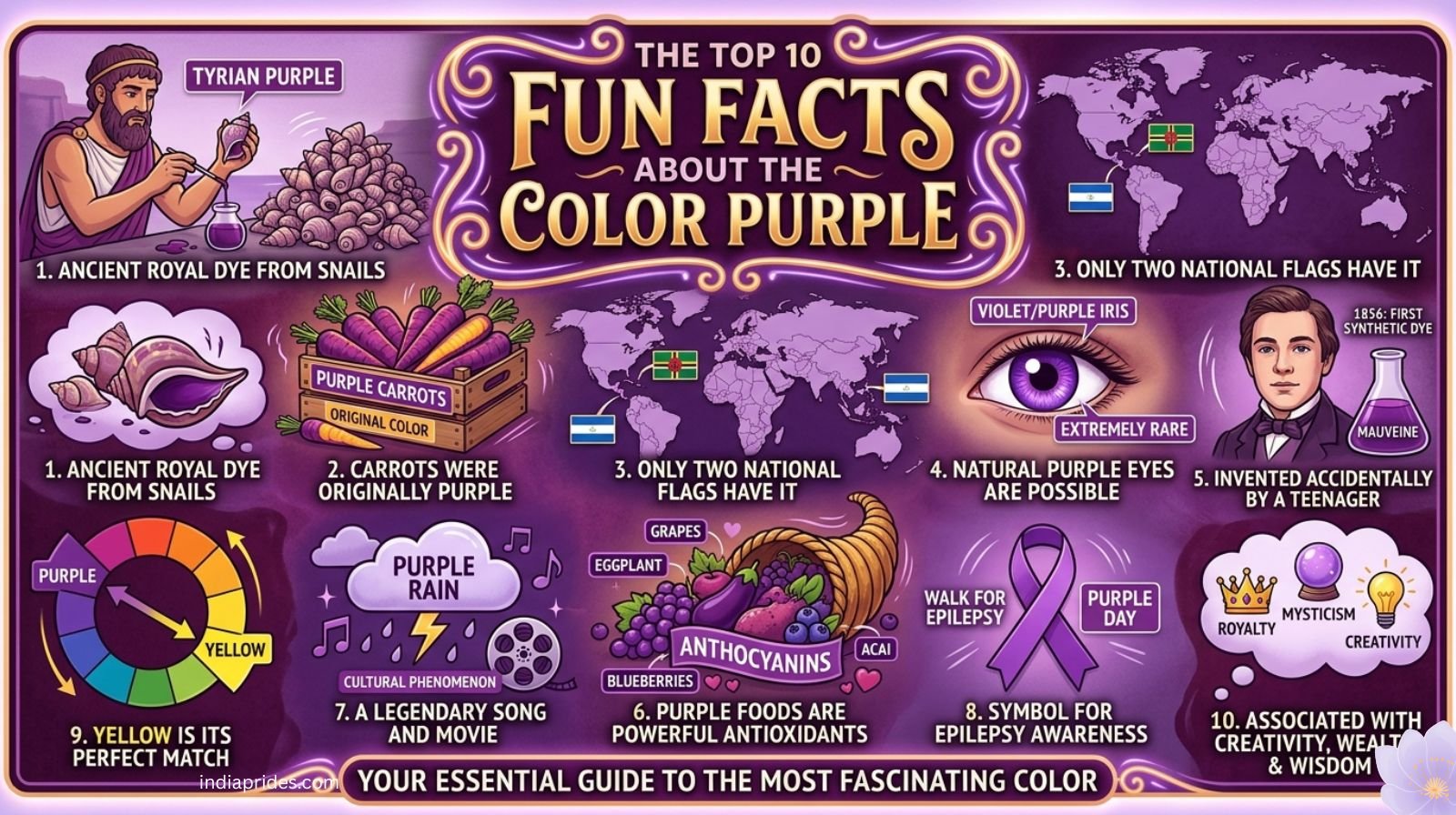
1. Purple is the “Color of the Gods” (and Expensive Snails)
For thousands of years, wearing purple wasn’t just a fashion choice; it was a display of immense wealth. This is because of Tyrian Purple, the most prized dye in the ancient world.
- The Snail Secret: The dye was extract from the hypobranchial gland of a small sea snail call the Murex.
- Labor Intensity: It took approximately 12,000 snails to produce just 1.5 grams of pure dye—barely enough for the trim of a single garment.
- The Scent of Luxury: Interestingly, the dye process was incredibly foul-smelling, but the resulting color was the only one that became brighter and richer when exposed to sunlight and weathering.
2. It Was Once Illegal for You to Wear It
In 2026, we take our fashion freedom for granted, but for centuries, your closet was regulate by sumptuary laws.
- The Roman Elite: In Ancient Rome, only the Emperor and high-ranking officials were allow to wear the toga picta, a solid purple garment.
- Elizabethan England: Queen Elizabeth I forbade anyone except the closest members of the Royal Family from wearing purple.
- Social Hierarchy: Being caught in purple if you weren’t “noble” could result in heavy fines or even harsher punishments. It was the ultimate status symbol.
3. Purple Doesn’t Actually Exist on the Light Spectrum
Prepare to have your mind blown: Technically, purple is a figment of your imagination.
- The Spectrum Gap: If you look at a rainbow (the visible light spectrum), you see violet at one end and red at the other. There is no single wavelength for “purple.”
- Brain Magic: Purple is a “non-spectral” color. Our brains “invent” purple when our eyes receive both red and blue light simultaneously but no green light.
- Purple vs. Violet: While they look similar, violet is a real spectral color with its own specific wavelength. Purple is a composite color create by our neural processing.
4. The First Synthetic Dye Was a “Purple Accident”
The modern fashion industry changed forever in 1856 because of an 18-year-old chemistry student named William Henry Perkin.
- The Failed Experiment: Perkin was trying to synthesize quinine (a cure for malaria). Instead, he ended up with a thick, dark sludge.
- Mauveine: He noticed the sludge turned silk a beautiful, permanent shade of light purple. He called it Mauveine.
- Mass Production: This was the first synthetic chemical dye, making purple affordable for the general public for the first time in history. The “Mauve Decade” followed, and the world was never the same.
5. It is the Most Common Color for “Spiritual Power”
In the world of color psychology and holistic wellness, purple occupies a unique space.
- The Crown Chakra: In many Eastern traditions, purple (or violet) represents the Sahasrara, or the Crown Chakra, associated with higher consciousness and enlightenment.
- Creativity and Mystery: Psychologically, purple is link to the “flow state” of artists and musicians. It balances the stability of blue with the energy of red.
- The 2026 Wellness Trend: From amethyst crystals to ambient purple lighting in meditation apps, the color is used to reduce anxiety and promote deep, restorative sleep.
6. Purple is Surprisingly Rare in the Natural World
While we love purple flowers and fruits, they are statistically rare compared to greens, browns, and blues.
- Pollinator Attraction: Plants like lavender, violets, and orchids use purple to stand out to bees and butterflies, who see the UV spectrum and find purple blossoms highly visible.
- Animal Rarity: Purple animals are incredibly rare. Aside from the Purple Emperor butterfly or certain sea creatures like the Purple Sea Urchin, you won’t find many purple mammals or birds.
- Anthocyanins: The pigment responsible for purple in plants—anthocyanins—also acts as a natural sunscreen, protecting delicate tissues from UV damage.
7. It Is the Color of “The Brave” in the Military
The Purple Heart is one of the most respected honors in the United States military, and its history is deeply symbolic.
- Washington’s Badge: Originally established by George Washington in 1782 as the “Badge of Military Merit,” it was the first American award for common soldiers.
- Wounded in Action: Today, it is awarded to those wound or killed in the line of duty.
- The Symbolism: The color was chosen to represent the “noble blood” spilled by soldiers, regardless of their rank or social standing.
8. Carrots Used to be Purple by Default
If you travelled back to the 10th century, your dinner plate would look very different.
- The Original Veggie: Domesticated carrots originated in Persia and were naturally dark purple or yellow.
- The Orange Revolution: Legend has it that the orange carrot was develop by Dutch farmers in the 17th century to honor the House of Orange.
- Nutritional Power: In 2026, purple carrots are making a massive comeback as a “superfood” because their purple pigment is packed with powerful antioxidants.
9. Only Two National Flags Contain Purple
Despite its popularity, purple is almost non-existent on the world’s national flags.
- The Cost Factor: Because purple dye was so expensive for most of history, nations couldn’t afford to mass-produce flags with that color.
- The Exceptions: Only Dominica (featuring the Sisserou Parrot) and Nicaragua (which has a tiny rainbow in its coat of arms) feature purple on their national flags.
- The Modern Shift: While not on flags, purple is becoming the go-to color for modern political movements seeking to represent a “unity” of red and blue ideologies.
10. Purple is the Color of the Universe (Literally)
In the world of astrophysics and 2026 space exploration, purple is the color of the great unknown.
- Nebulae and Galaxies: High-resolution images from the James Webb Space Telescope often show stunning clouds of purple gas and dust where stars are being born.
- Ultraviolet Light: While humans can’t see pure UV light, it is often represent as purple in “false-color” astronomical images to help us visualize the energy of the cosmos.
- The “Purple Earth” Hypothesis: Some scientists believe that early life on Earth (billions of years ago) may have been purple instead of green, using retinal instead of chlorophyll to absorb sunlight.
Conclusion: The Magic of the Middle Ground
Purple is more than just a color; it is a bridge. It bridges the gap between the earth and the stars, between the physical and the spiritual, and between history and the future. From the ancient sea-snails of Tyre to the AI-generated art of 2026, purple continues to fascinate and inspire.
Next time you see a purple orchid or a violet-tinged twilight, remember that you are looking at a color that defied the laws of physics, bankrupted kings, and currently defines the cutting edge of global luxury.
Frequently Asked Questions (FAQs)
Q: Is purple or violet better for sleeping?
A: In 2026, soft lavender or violet hues are highly recommended for bedrooms. These colors have a lower frequency that helps calm the nervous system and triggers melatonin production.
Q: Why is purple associated with magic?
A: Because it is rare in nature and was historically difficult to create, it was seen as “otherworldly.” This association stuck, making it the primary color for fantasy and magic in pop culture.
Q: Can pets see the color purple?
A: Dogs see the world primarily in blues and yellows. To them, purple likely appears as a shade of blue. However, bees and birds can see ultraviolet purple, which is invisible to humans!