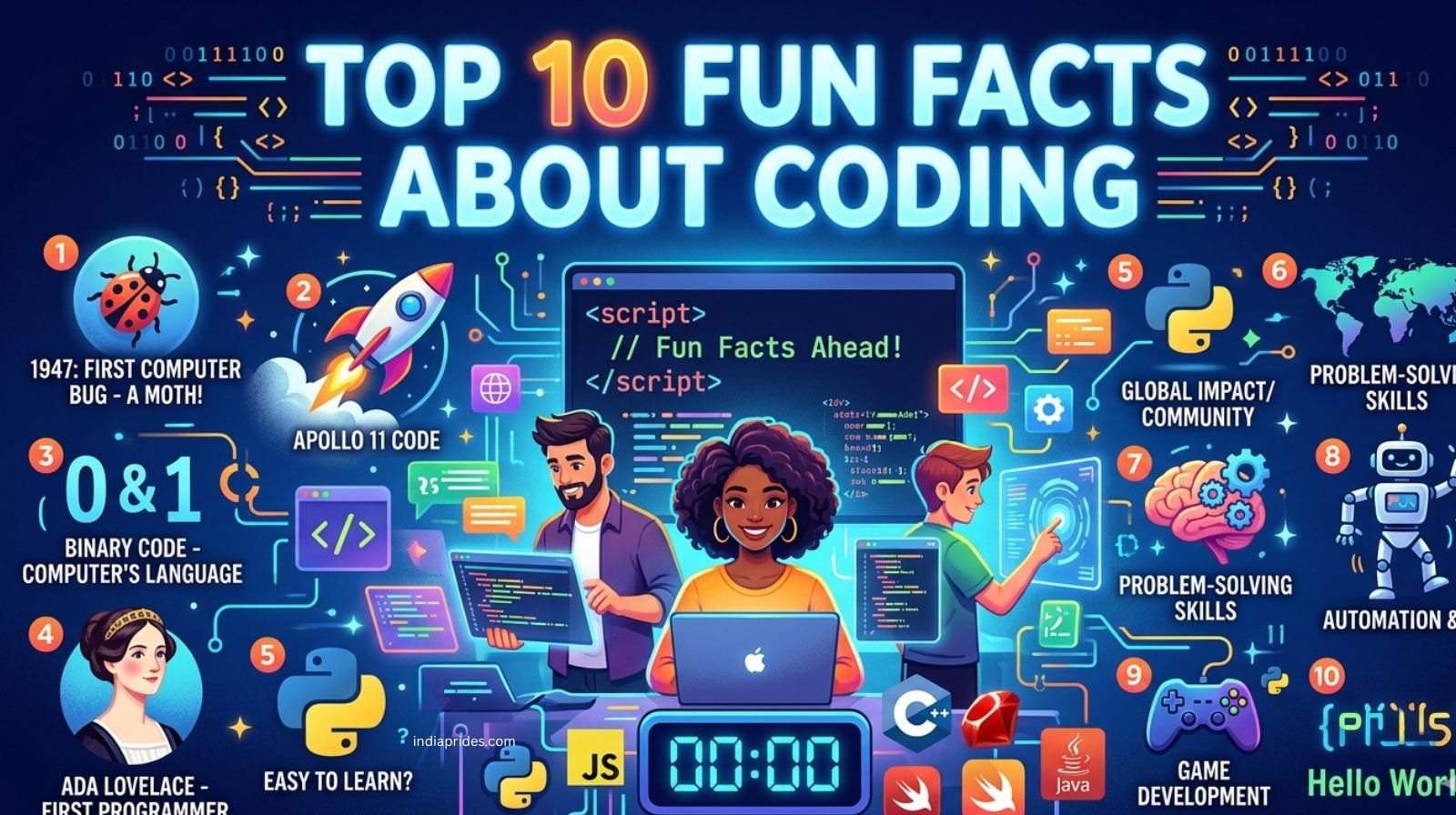
We live in an era where our lives are dictate by invisible lines of text. From the alarm that wakes you up to the complex algorithms suggesting your next favorite song, computer programming is the heartbeat of modern civilization. But beyond the glowing screens and dark-themed code editors lies a world filled with bizarre origins, accidental discoveries, and mind-bending statistics.
If you have ever wonder what goes on behind the “Matrix” or why developers are obsess with coffee, this deep dive is for you. Here are the top 10 fun facts about coding that prove software development is as much an art form as it is a science.
1. The First Programmer Was a Woman
Long before the first electronic computer was ever built, the logic of programming was already being mapped out. Ada Lovelace, an English mathematician, is widely recognized as the world’s first computer programmer.
- The Analytical Engine: In the mid-1800s, she worked with Charles Babbage on his “Analytical Engine.”
- The First Algorithm: She wrote an algorithm intend to be process by a machine, making her a pioneer of computational thinking.
- Visionary Insight: While others saw computers as mere calculators, Ada realized that a machine could manipulate symbols and create music or art if programmed correctly.
2. The First “Computer Bug” Was a Real Moth
Ever wonder why we use the term “bug” to describe a software error? In 1947, the term became literal. Grace Hopper, a legendary computer scientist, was working on the Harvard Mark II computer when it began to malfunction.
- Physical Inspection: Upon opening the machine, the team found a moth stuck in a relay, preventing the hardware from functioning.
- The Logbook: They taped the moth into their logbook with the caption, “First actual case of bug being found.”
- Debugging History: Since then, the process of fixing code has been known as debugging, a term that has outlasted the vacuum tubes of the 1940s.
3. There Are Over 700 Programming Languages
When people talk about learning to code, they often ask, “Which language?” The answer is complicate because there are over 700 different programming languages in existence.
- Diversity of Purpose: Some languages, like Python, are designed for readability and AI, while others, like C++, are built for high-performance gaming and operating systems.
- Esoteric Languages: There are even “joke” languages like Brainfuck (which is nearly impossible to read) and Shakespeare, where the code looks like a 16th-century play.
- The Big Three: Despite the variety, the majority of the world’s software runs on a handful of giants: JavaScript, Python, and Java.
4. Coding is Moving Toward “Natural Language”
In the early days, programmers had to speak the language of the machine (zeros and ones). Today, modern programming is becoming increasingly similar to English.
- High-Level Languages: Languages like Python allow developers to write commands that look like standard sentences, such as
print("Hello World"). - The AI Revolution: With the rise of Artificial Intelligence and Large Language Models, we are entering an era of “Natural Language Programming,” where you can tell an AI what you want in plain English, and it generates the code for you.
- Accessibility: This shift is making tech careers more accessible to people without traditional engineering backgrounds.
5. NASA Still Uses Code from the 1970s
In the world of software engineering, “new” isn’t always “better.” NASA’s Voyager 1 and Voyager 2 spacecraft, launched in 1977, are still communicating with Earth using code written decades ago.
- Robustness over Flashiness: This code was design to be incredibly efficient because the onboard computers had less memory than a modern digital watch.
- Remote Updates: Engineers at NASA still send patches and updates to these probes across billions of miles of space.
- Assembly Language: Much of this legacy code is written in Assembly, a low-level language that interacts directly with the computer hardware.
6. The First Computer Game Had No Graphics
Today, we have 4K resolutions and virtual reality, but the history of game development started in a much humbler place. The first recognized computer game, Spacewar!, was create in 1962.
- MIT Roots: It was developed by Steve Russell and a team at MIT on a machine the size of a refrigerator.
- Vector Display: Instead of pixels, it used dots and lines on an oscilloscope-like screen.
- Open Source Spirit: The code for Spacewar! was shared freely among researchers, planting the early seeds of the open-source movement.
7. Coding Can Be a “Full-Body” Workout for the Brain
Scientific studies using fMRI scans have shown that coding affects the brain in fascinating ways. Contrary to popular belief, it doesn’t just activate the “math” centers of the mind.
- Language Centers: When experienced programmers read code, the parts of the brain associated with language processing (like Broca’s area) are highly active.
- Working Memory: Writing complex logic requires intense use of the brain’s “working memory,” similar to how a grandmaster plays chess.
- Neuroplasticity: Regularly practicing algorithmic problem-solving can actually strengthen the neural pathways associated with logic and sensory-motor coordination.
8. 90% of the World’s Data Was Create in the Last Two Years
This staggering statistic is only possible because of the efficiency of backend programming and database management.
- Data Explosion: Every time you click, swipe, or stream, code is generating data.
- Big Data: Data Science and Machine Learning are the fields of coding dedicated to making sense of this massive “ocean” of information.
- Storage Challenges: Programmers are constantly inventing new ways to compress and store data, moving from physical hard drives to cloud computing and even experimental DNA storage.
9. A 15-Year-Old Once Hacked NASA
In 1999, Jonathan James, a teenager using the handle “c0mrade,” hacked into the Marshall Space Flight Center in Alabama.
- The Breach: He stole software worth $1.7 million, which forced NASA to shut down its computers for three weeks, costing $41,000 in repairs.
- Cybersecurity Evolution: This event was a wake-up call for the world, leading to a massive surge in the field of Cybersecurity and “Ethical Hacking.”
- The Lesson: It proved that a single individual with a keyboard and enough coding knowledge could challenge the world’s most powerful institutions.
10. Computers Don’t Actually “Understand” Your Code
This is perhaps the most mind-blowing fact: Computers are actually quite “dumb.” They don’t understand Java, Python, or C++.
- Binary is King: At the end of the day, every piece of software is convert into Binary—a series of 1s and 0s representing electrical “on” and “off” states.
- Compilers and Interpreters: These are special programs that act as translators, taking the human-readable code and turning it into Machine Code.
- Logic Gates: Everything you see on your screen—from a high-definition movie to a text message—is just a result of billions of tiny switches flipping on and off at lightning speed.
Why Coding is the Ultimate Skill for 2026
As we navigate through 2026, programming literacy is becoming as important as reading and writing. It isn’t just for “geeks” in basements anymore; it’s for doctors, artists, farmers, and entrepreneurs.
The beauty of computer programming is that it allows you to build something out of nothing. With just a laptop and an internet connection, you can create an app that reaches millions of people or an algorithm that solves a global crisis.
Conclusion
From the moth in the machine to the 700+ languages we use today,
the world of code is a testament to human curiosity. Whether you are a seasoned Full-Stack Developer or someone just starting their coding journey,
remember that every line of code you write is part of a history that dates back to the 19th century.
Coding is more than just a career; it is the language of the future. So, keep typing, keep debugging, and most importantly, keep creating!