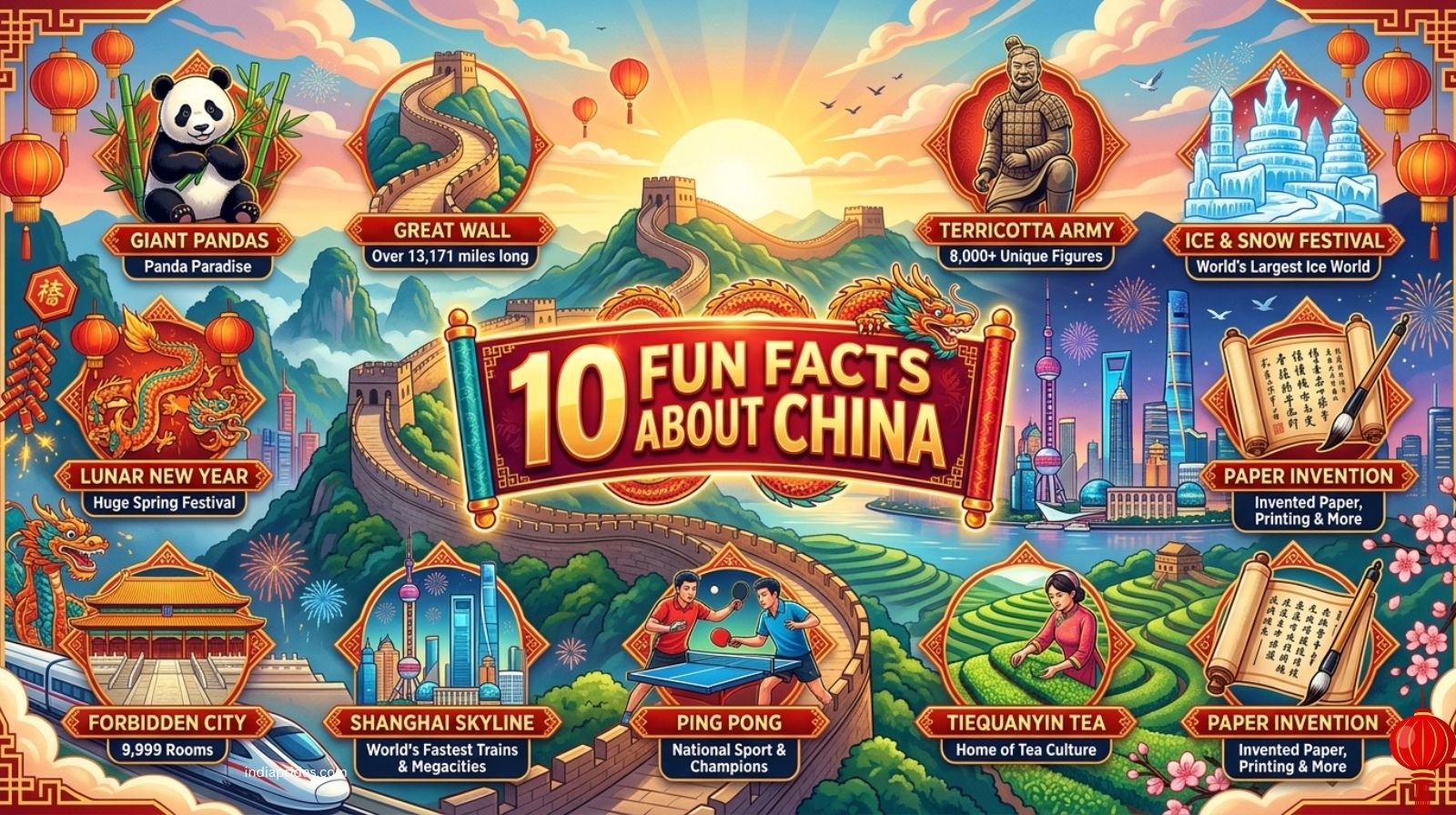
China is not just a country; it is a civilization that has outlasted empires, reinvented technology, and maintained a cultural thread for over 5,000 years. Known as the “Middle Kingdom,” it is a place where ancient tea ceremonies happen in the shadow of neon-lit skyscrapers that reach for the clouds. Whether you are a history buff, a tech enthusiast, or a foodie, China offers a scale of existence that is hard to wrap your head around.
In this comprehensive exploration, we are counting down the top 10 fun facts about China that highlight its massive influence on the world. Get ready to discover the hidden secrets of the Great Wall, the truth about Giant Pandas, and why China is essentially living in the future.
1. A Single Time Zone for a Massive Nation
Geographically, China is nearly the same size as the continental United States. In the U.S., you would cross four different time zones traveling from coast to coast. However, in China, the entire country operates on a single time zone: Beijing Standard Time (CST).
- The Reason: This was implement in 1949 to promote national unity.
- The Result: In western provinces like Xinjiang, the sun might not rise until 10:00 AM in the winter, and people eat dinner at midnight.
- The Quirks: Despite the official clock, many locals in the west use an unofficial “local time” to keep their biological rhythms in sync with the sun.
2. All Giant Pandas Belong to China
The world’s most adorable diplomats are actually on loan. Every Giant Panda you see in a zoo across the globe—from Washington D.C. to Berlin—technically belongs to the Chinese government.
- Panda Diplomacy: China uses “Panda Diplomacy” as a sign of friendship and trust with other nations.
- The Rental Agreement: Zoos typically pay an annual “rental fee,” which China uses for wildlife conservation and habitat restoration.
- The Baby Clause: Even if a panda is born in a foreign zoo, it remains the property of China and must eventually be return to join the breeding program in Sichuan province.
3. The “New Four Great Inventions”
We all know ancient China gave the world paper, gunpowder, the compass, and printing. But modern China is being defined by the “New Four Great Inventions” that have transformed daily life in the 21st century.
- High-Speed Rail: China has the world’s largest high-speed rail network, with tracks that could circle the Earth twice.
- Mobile Payments: In major cities, cash is nearly obsolete. Everyone from luxury malls to street food vendors uses Alipay or WeChat Pay.
- E-commerce: China’s online shopping festivals, like Singles’ Day, dwarf Black Friday and Cyber Monday combined.
- Bike Sharing: Massive fleets of app-controlled bicycles have redefined urban mobility in Chinese megacities.
4. Ice Cream Was Invented in China
While the Italians perfected it and the Americans popularized it, the very first versions of ice cream originated in China around 200 BC.
- The Original Recipe: Ancient Chinese inventors created a frozen mixture of milk, rice, and snow.
- The Cooling Trick: They discovered that adding saltpeter to water lowered its freezing point, allowing them to create ice even in warmer months.
- The Marco Polo Legend: It is widely believed that explorer Marco Polo brought the concept of “milk ice” back to Italy, which eventually evolved into the gelato we love today.
5. The Great Wall is Held Together by Sticky Rice
The Great Wall of China is a marvel of engineering, but its longevity isn’t just due to stone. The secret ingredient in the mortar used during the Ming Dynasty was actually sticky rice.
- Chemical Reaction: The amylopectin in the rice created a chemical bond with the lime, making the mortar incredibly strong and water-resistant.
- Durability: This “sticky rice mortar” is so tough that in many places, weeds still cannot grow between the bricks, and the wall has survived massive earthquakes.
- Fun Fact: It is a myth that you can see the Great Wall from the moon with the naked eye, but its cultural significance is certainly cosmic!
6. A Forest of Skyscrapers
China’s urbanization is the fastest in human history. To accommodate its population, the country has built more skyscrapers in the last decade than the rest of the world combined.
- The Vertical City: China is home to 5 of the top 10 tallest buildings in the world.
- The Shenzhen Miracle: Forty years ago, Shenzhen was a small fishing village; today, it has more skyscrapers than New York City.
- Future Infrastructure: China uses more concrete in three years than the United States used in the entire 20th century.
7. The World’s Oldest Living Language
Chinese characters (Hanzi) represent the oldest writing system in the world that is still in active use today.
- Logographic System: Unlike the English alphabet, Chinese characters represent meanings rather than just sounds.
- Continuity: A modern Chinese student can look at a 2,000-year-old inscription and recognize many of the characters, a feat nearly impossible for speakers of most other languages.
- Mandarin Power: Mandarin Chinese is the most spoken native language on the planet, with over a billion speakers.
8. Ping Pong is the National Passion
While basketball and soccer are popular, Table Tennis (Ping Pong) is the undisputed national sport of China.
- Mass Participation: You can find concrete ping pong tables in almost every public park, school, and neighborhood.
- Global Dominance: Since the sport was added to the Olympics, Chinese players have won nearly every gold medal available.
- Ping Pong Diplomacy: In the 1970s, table tennis matches between American and Chinese players helped pave the way for the restoration of diplomatic relations between the two countries.
9. The World’s Largest High-Speed Rail Network
Traveling across China used to take days; now it takes hours. China has built a bullet train infrastructure that is the envy of the world.
- Speed: These trains regularly cruise at 350 km/h (217 mph), making domestic flights almost unnecessary for many routes.
- The Bridge Factor: To keep the tracks level, China has built the world’s longest bridges, including the Danyang-Kunshan Grand Bridge, which spans 102 miles.
- Connectivity: Even remote mountainous regions are now connected to the economic hubs of Shanghai and Beijing, driving massive growth in internal tourism.
10. Lunar New Year: The Largest Human Migration
Every year, China hosts the Chunyun, or the Spring Festival travel rush. It is officially the largest annual human migration on Earth.
- Going Home: Hundreds of millions of people travel across the country simultaneously to celebrate the Lunar New Year with their families.
- The Scale: During this 40-day period, billions of passenger trips are made via rail, road, and air.
- Tradition: It is a time for red envelopes (Hongbao), fireworks, and eating dumplings, which are shaped like ancient silver ingots to symbolize wealth and prosperity.
Why China Captivates the World
From the Silk Road of the past to the Silk Road of the Future (Belt and Road Initiative), China is a country that never stops evolving. It manages to balance a deep respect for Confucian values and ancestral traditions with a relentless drive for technological supremacy.
Whether it’s the fact that they use more silk than anyone else, or that they invented the umbrella, every detail of Chinese life is a testament to human ingenuity. If you ever get the chance to walk through the Forbidden City or see the Terracotta Army in Xi’an, you’ll realize that these fun facts are just the beginning of a much larger story.
Conclusion
China is a land of extremes—extremely old, extremely fast, and extremely innovative. These fun facts about China prove that the country is much more than a manufacturing hub; it is a cultural powerhouse that continues to shape the 21st century.