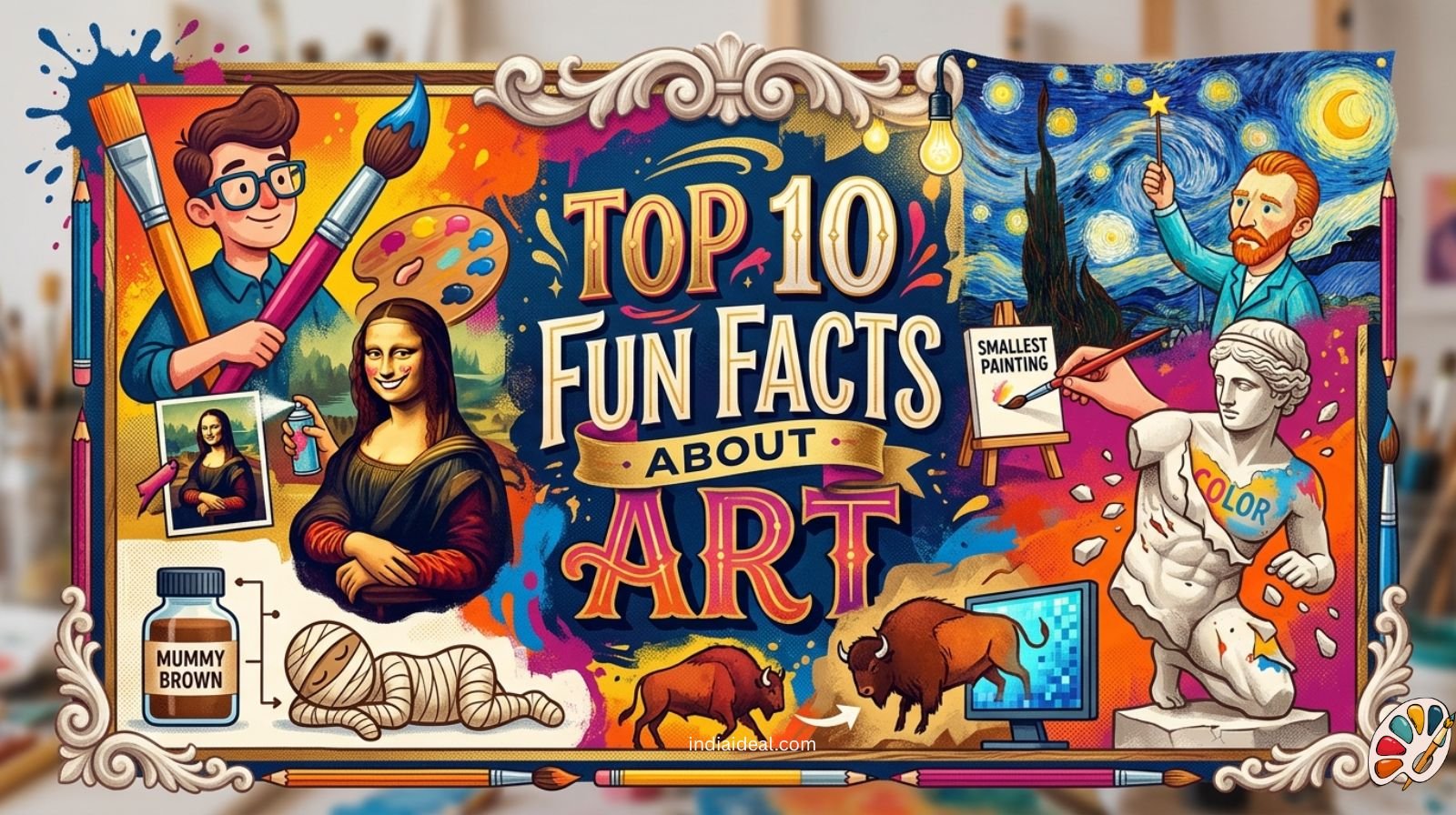
Art is the universal language of the human soul. From the jagged charcoal lines on prehistoric cave walls to the vibrant, neon-lit digital galleries of 2026, art has been our most enduring witness. It captures what words cannot—emotion, revolution, and the sheer absurdity of existence. But behind the billion-dollar auctions and the hushed silence of the Louvre, there lies a world of bizarre coincidences, hidden messages, and historical “glitches.”
Whether you are a seasoned connoisseur or someone who simply enjoys a good van Gogh print, these stories add a layer of magic to every brushstroke. Prepare to dive deep into the vault as we explore the Top 10 fun facts about art that prove history is often stranger than fiction.
1. The Mona Lisa Wasn’t Always Famous (The Heist That Made a Legend)
It might shock you to learn that for centuries, the Mona Lisa was just another painting in the Louvre.
It wasn’t considered the “greatest of all time” until 1911. What changed? It was stolen.
A museum employee named Vincenzo Peruggia walked out with the masterpiece hidden under his smock. The resulting media circus, international manhunt, and the two-year vacancy on the museum wall turned Leonardo da Vinci’s portrait into a global icon. When it was finally return, thousands of people who had never cared about art flocked to see the painting that had vanished.
- Fun Fact: During the two years she was missing, people actually queued up just to look at the empty space on the wall where she used to hang.
- Artistic Secret: Da Vinci spent over 14 years on this painting and allegedly died before he felt it was truly “finish.”
2. Art Used to Be an Official Olympic Sport
Between 1912 and 1948, the Olympic Games weren’t just about sprinting and swimming. The founder of the modern Olympics, Pierre de Coubertin, believed that a true Olympian should be both an artist and an athlete.
Medals were awarded for architecture, literature, music, painting, and sculpture. The only catch?
Every entry had to be inspired by the concept of sport.
- The Downfall: The category was eventually scrapped because artists were considered “professionals,” while Olympians at the time were required to be “amateurs.”
- 2026 Perspective: In today’s world of digital art and NFTs, many are calling for a “Creative Olympics” to return to the global stage.
3. The “Color Out of Space”: Ultramarine Was More Expensive Than Gold
During the Renaissance, the color blue was a symbol of extreme wealth. The pigment, known as Ultramarine, was made by grinding up a semi-precious stone called Lapis Lazuli,
which had to be imported all the way from the mines of Afghanistan.
Because it was so prohibitively expensive—costing more than its weight in gold—artists typically reserved it for the most sacred subjects, such as the robes of the Virgin Mary.
- Michelangelo’s Struggle: It is rumored that Michelangelo left his painting The Entombment unfinished because he couldn’t afford to buy more Ultramarine.
- Modern Era: Today, we use synthetic blue, but the depth of original Lapis Lazuli remains unmatched in historical restoration.
4. Vincent van Gogh Only Sold One Painting During His Lifetime
The story of Vincent van Gogh is perhaps the most poignant in art history. While his works like The Starry Night now sell for hundreds of millions of dollars, Vincent lived in near-constant poverty.
He created over 2,100 artworks in just a decade, but he only officially sold one painting while he was alive: The Red Vineyard.
- The Buyer: It was purchased by Anna Boch, a fellow painter, for 400 Francs (about $2,000 in today’s money).
- Posthumous Fame: Van Gogh’s sister-in-law, Jo van Gogh-Bonger, is the unsung hero who spent years after his death tirelessly promoting his work until the world finally took notice.
5. Salvador Dalí’s “Cheating” Signature Technique
The Surrealist master Salvador Dalí was as much a marketing genius as he was a painter. He loved his wealthy lifestyle and found a very “surreal” way to pay for his expensive meals at restaurants.
Dalí would often draw intricate sketches on the backs of the checks he used to pay for dinner. He knew that no restaurant owner in their right mind would ever cash a check that had an original Dalí drawing on the back! The sketch was worth ten times the meal, so the checks remained uncashed, and Dalí essentially ate for free.
- The Chupa Chups Logo: Did you know Dalí also designed the logo for the famous Chupa Chups lollipop?
He insisted it be place on top of the wrapper so it was always visible.
6. Picasso Was a Suspect in the Theft of the Mona Lisa
Returning to the Mona Lisa heist of 1911—police were so desperate for leads that they actually arrested the famous poet Guillaume Apollinaire, who then implicated his friend, Pablo Picasso.
Picasso was brought in for questioning because
he had previously purchased Roman statuettes that had been stole from the Louvre by a different thief.
- The Courtroom Drama: Picasso reportedly wept in court and denied even knowing Apollinaire. Eventually, both were clear of the Mona Lisa theft, but the incident remained a dark stain on Picasso’s early career.
- Guernica Legacy: Despite this drama, Picasso went on to create Guernica, arguably the most powerful anti-war painting in history.
7. The Hidden Anatomy in Michelangelo’s Sistine Chapel
Michelangelo was a master of human anatomy, often performing clandestine dissections to understand the body. When he painted the ceiling of the Sistine Chapel, he may have hidden his scientific knowledge right under the Pope’s nose.
In the famous panel The Creation of Adam, the shape of the red cloak surrounding God is an anatomically correct illustration of the human brain.
- The Theory: Some art historians believe Michelangelo was suggesting that the “gift of intellect” was as divine as the soul itself.
- The Spine: In another panel, the depiction of God’s neck and throat mirrors the anatomy of a human spinal cord and brain stem.
8. The World’s Largest Art Gallery is the Hermitage
If you spent just one minute looking at every single object in the State Hermitage Museum in Saint Petersburg, it would take you 11 years to see everything.
The museum houses over 3 million items, including the world’s largest collection of paintings.
- The Guardians: The museum is famous for its “Hermitage Cats.” Since the 18th century, cats have been employed by the museum to protect the precious artworks from mice and rats. They even have their own press secretary!
9. Leonardo da Vinci Could Write with One Hand and Draw with the Other
Da Vinci was the ultimate Polymath. His brain functioned on a level that few have ever reached. He was ambidextrous and famously practiced mirror writing,
writing from right to left so that his notes could only be read when held up to a mirror.
Even more impressively, he could reportedly write a formal letter with one hand while simultaneously sketching a masterpiece with the other.
- The Notebooks: His codices contain designs for flying machines, tanks, and even a primitive robot—all drawn with a level of artistic precision that looks like modern blueprints.
10. The Color “Vantablack” Sparked an Artist War
In the modern art world, colors can be “owned.” Vantablack is one of the darkest substances known, absorbing 99.96% of light. It makes 3D objects look like flat, 2D black holes.
The artist Anish Kapoor bought the exclusive rights to use Vantablack in art, sparking a massive feud in the creative community.
- The Retaliation: Artist Stuart Semple responded by creating the “World’s Pinkest Pink” and “World’s Glitteriest Glitter,” banning Anish Kapoor from ever buying them.
- 2026 Update: This “Color War” pushed the boundaries of material science in art, leading to even darker blacks and more vibrant pigments available to the public today.
Why Art Facts Matter in 2026
In an era dominated by Artificial Intelligence and generative art, understanding the human history behind these masterpieces is more important than ever. These fun facts about art remind us that art isn’t just about a finished product; it’s about the obsession, the failure, the ego, and the genius of the people who held the brush.
Quick Recap of Art Trivia:
- Mona Lisa: Became a star through a heist.
- Olympics: Art was a competitive sport for 36 years.
- Blue Paint: Was literally worth more than gold.
- Picasso: Was a prime suspect in a museum robbery.
- Dalí: Used art to avoid paying dinner bills.
Art is a living entity. Every time you share one of these facts or visit a local gallery, you are keeping that 40,000-year-old conversation alive.