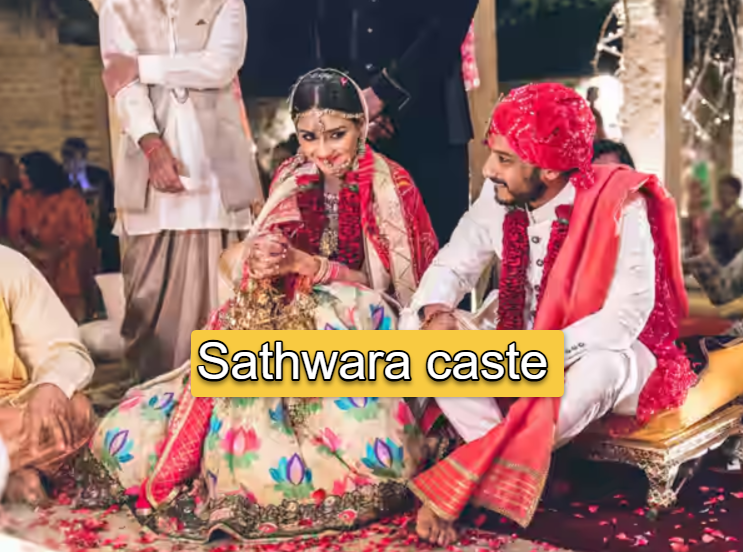
Districts of Baroda, Surat and Saurashtra have the OBC Hindu community called Sathwara. The community members are involved in practising agricultural trade who later evolved as Rajputs. The Gujarat government categorises them under the socially backward community. They were historically engaged in practising manual labour and were devoid of due social respect.
The Sathwara caste members interchangeably use sathvara and satwara as their surnames. They were mainly the construction labourers or masons who were deeply involved in physical activities. Most of the community members still live in the interior areas of Gujarat and continue to opt for physical labour as a source of livelihood.
What is Sathwara culture and origin?
Sathwara samaj can be vegetarian or non-vegetarian depending on their personal choices and regional areas. They mostly believe in marrying the Sathwara caste under the Hindu religious norms. The group worships the usual Hindu deities like Lord Krishna and Shiva. They speak kutchu and Gujarati as their mother tongue.
Sathwara caste kuldevi
The Gujarati OBC caste also remains a vivid part of the Swaminarayan community. The individuals use Kushwaha surname quite often and refer to Aadhaar Devi Temple in Rajasthan for ensuring the prosperity and the existence of the clan. Kuldevi of the caste lays down the guidelines for tradition and marital ceremonies. The community has plenty of Gujarati impact in their traditions because of the regional influence.
The history of Sathwaras
One of the most important things to be noted about the OBC caste is that they were not originally Kurmis. One of the stories related to the community talks about a tradition where a Kurmi wife went to Saurashtra while leaving everything behind. These individuals even left their original Kshathriya caste and escaped the anger of Parasurama. They left weaponry altogether and took farming as their profession. Since those times, the origin of Sathwara Samaj took place.
The mediaeval period witnessed inter-caste marriages between the Rajputs and Sathwara which resulted in the major reason for their conversion. The Ancestry of the caste is often found in the Solanki, Rathore, Dubi, Kacheria, Chavda and parmar clans.
The current scenario of Sathwara
Even in the current time period, Sathwara Samaj members can be found in the districts of Junagadh, Jamnagar, Bhavnagar and Surendranagar. Their dietary habits differ according to the sections of the states. They are divided into multiple clans and have adopted variable cultures with a few basic ones applying to all the caste members. Overall, there are similarities found in all the caste members as they are still engaged in the traditional physical labour and farming activities.
Final words
Specifically found in the areas of Gujarat, Sathwara samaj members are now given government protection and reservations. The individuals are understanding the importance of jobs education and fulfilment while leaving their ancestral occupations. The present generation members are leaving their village areas and choosing urban dwelling for their survival and revival. A complete assistance provided by the Indian government. Hence, the future of the generation of the caste is expected to be much brighter and financially stable than today.