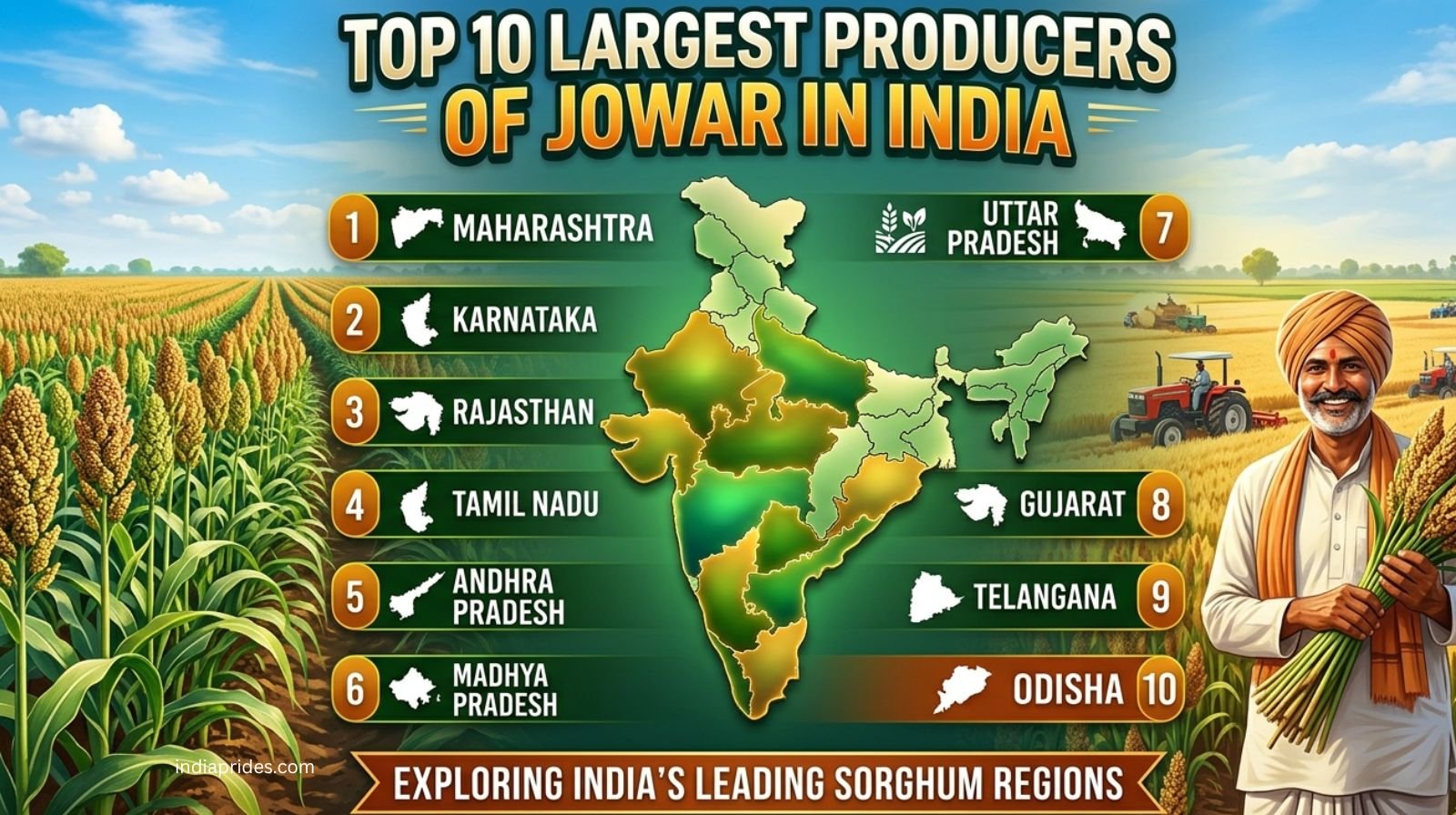
In the heart of India’s semi-arid landscapes, one crop stands as a symbol of endurance, nutrition, and sustainability: Jowar (Sorghum). As we move through 2026, the global focus on climate-smart agriculture has catapulted Jowar from a humble “coarse grain” to a prestigious superfood. India remains the world leader in sorghum cultivation, serving as a vital source of both food for humans and high-quality fodder for livestock.
Jowar is a remarkable crop that thrives where others wither. It requires minimal water, tolerates high temperatures, and provides a gluten-free powerhouse of fiber and protein. For the Indian farmer, it is a reliable safeguard against the unpredictable monsoons of the 21st century. If you are tracking the agricultural powerhouses of the subcontinent, this guide to the top 10 largest producer of jowar in India will provide the data-driven insights you need.
1. Maharashtra: The Undisputed Sovereign
Maharashtra is not just a participant in the millet revolution; it is the leader. It remains the largest producer of jowar in India, contributing nearly 50% of the national output.
- Scale of Production: Maharashtra produces over 14 to 15 lakh tonnes annually, covering a massive area of 16 lakh hectares.
- Regional Hubs: The districts of Solapur, Sangli, Pune, and Ahmednagar are the core of the Jowar belt, where the grain is a dietary staple in the form of Bhakri.
- Dual-Season Advantage: Unlike many states, Maharashtra cultivates Jowar in both the Kharif (monsoon) and Rabi (winter) seasons, ensuring a year-round supply.
- Support Systems: The state government has pioneered subsidies for drought-resistant seeds, solidifying Maharashtra’s status as the largest producer of jowar in India.
2. Karnataka: The Southern Engine
Karnataka consistently holds the second position, with its North-Eastern districts acting as a major supply hub for the peninsula.
- Production Output: The state contributes approximately 7.06 lakh tonnes to the national pool.
- Key Districts: Vijayapura, Bagalkot, Dharwad, and Kalaburagi are synonymous with high-quality Jowar production.
- Nutritional Legacy: In North Karnataka, Jowar is more than a crop; it is a cultural icon, forming the primary base for local cuisine.
- Modern Shift: While acreage has seen some decline due to commercial crops, the state is revitalizing production through its dedicated Millet Missions.
3. Rajasthan: The Desert Warrior
Rajasthan’s arid climate makes Jowar a natural fit for its landscape. It ranks third, proving that the largest producer of jowar in India title is won through resilience.
- Arid Adaptation: Rajasthan produces around 5.27 lakh tonnes, thriving in areas where water is a scarce luxury.
- Livestock Backbone: In Western Rajasthan, Jowar is equally value as a nutrient-rich fodder, supporting the state’s massive dairy and livestock industry.
- Bajra-Jowar Mix: While Rajasthan leads in Pearl Millet (Bajra), Jowar serves as a critical secondary crop for food security.
4. Uttar Pradesh: The Diversifying Power
Commonly known for its wheat and sugarcane, Uttar Pradesh has rapidly climbed the ranks by diversifying into nutri-cereals.
- Production Growth: With an output of approximately 4.62 lakh tonnes, UP has moved into the fourth spot.
- Bundelkhand Focus: The dry Bundelkhand region has become the Jowar capital of the state, where the crop acts as a climate insurance for local farmers.
- Government Push: The state has integrated millets into the Public Distribution System (PDS), encouraging more farmers to switch to Jowar.
5. Andhra Pradesh: The High-Yield Zone
Andhra Pradesh is a leader in agricultural efficiency, often reporting some of the highest yields per hectare for Jowar.
- Output Volume: The state contributes nearly 2.93 lakh tonnes from just 84,000 hectares.
- Rayalaseema Belt: Districts like Kurnool and Anantapur are the primary producers, focusing on both local consumption and industrial starch production.
- Technological Adoption: Farmers here use advanced seed planning to maximize output even in rain-fed conditions.
6. Tamil Nadu: The Traditional Preserver
Tamil Nadu’s Jowar production is deeply root in its traditional food culture, particularly in its drier districts.
- Production: The state produces roughly 2.8 lakh tonnes.
- Culinary Use: Jowar is used to make traditional Dosa, Porridge, and snacks, keeping the demand steady in local markets.
- Regional Pockets: Coimbatore, Madurai, and Tiruchirappalli are the key areas where Jowar remains a favorite alternative to rice.
7. Telangana: The Modern Millet Hub
Since its formation, Telangana has positioned itself as a modern champion of millets, with a strong focus on processing and value addition.
- Focused Cultivation: The state contributes significantly to the national pool, with Adilabad and Medak being the primary production zones.
- Millet Clusters: Telangana has created specialized clusters that help farmers process Jowar into “ready-to-eat” products for urban markets.
8. Madhya Pradesh: The Central Contributor
Madhya Pradesh acts as a vital bridge in the Jowar trade between the North and South of India.
- Rain-fed Success: The state’s black soil regions provide the perfect moisture retention for Jowar without the need for intensive irrigation.
- Diverse Utility: Much of the Jowar from MP is diverted to the poultry feed industry, where it serves as a high-protein substitute for maize.
9. Gujarat: The Commercial Maverick
In Gujarat, Jowar is treated as a commercial crop, often grown with high-efficiency irrigation systems.
- Hybrid Seeds: Gujarat is a pioneer in using Hybrid Jowar varieties that offer higher resistance to pests and diseases.
- Dairy Integration: The state’s massive dairy cooperatives utilize Jowar stalks as a primary silage source, creating a high-value ecosystem for farmers.
10. Haryana: The Emerging Northern Force
While Haryana is a small state geographically, its contribution to the millet basket is growing as farmers look for sustainable alternatives to water-heavy crops.
- Sustainable Shift: Haryana is encouraging Jowar cultivation to reduce the plummeting groundwater levels in its southern districts.
- Quality Grain: The grain produced here is often of premium quality, sought after by the health-food processing industry in the Delhi-NCR region.
Why Jowar is the “Smart Crop” of 2026
What makes the largest producer of jowar in India so significant to our future? It’s the sheer versatility of the grain:
- Gluten-Free Purity: As celiac disease awareness rises, Jowar has become the premier choice for healthy flour alternatives.
- Climate Resilience: Jowar can withstand temperatures up to 32°C and requires only 30-100 cm of rainfall.
- Soil Health: Jowar is a “low-input” crop, meaning it needs fewer fertilizers and chemicals, keeping the soil fertile for longer.
- Value Addition: In 2026, Jowar is being converted into pasta, cookies, and even biodegradable packaging, increasing its market value.
The Road Ahead for Jowar
Being the largest producer of jowar in India is a title that comes with responsibility. As climate change shifts traditional rainfall patterns, states like Maharashtra and Karnataka are leading the way in genomic mapping of Jowar to create even more resilient seeds.
- Bio-fortification: New varieties of Jowar are being developed with higher Zinc and Iron content to fight malnutrition.
- Ethanol Production: Jowar stalks are being used as a feedstock for second-generation biofuels, adding an industrial dimension to the crop.
Conclusion
India’s agricultural destiny is being reshaped by these 10 states. While Maharashtra continues its reign as the largest producer of jowar in India, the collective effort of the entire country is turning this ancient grain into a modern success story. By supporting Jowar, we aren’t just supporting a crop; we are supporting a sustainable, healthy, and resilient future for the world.