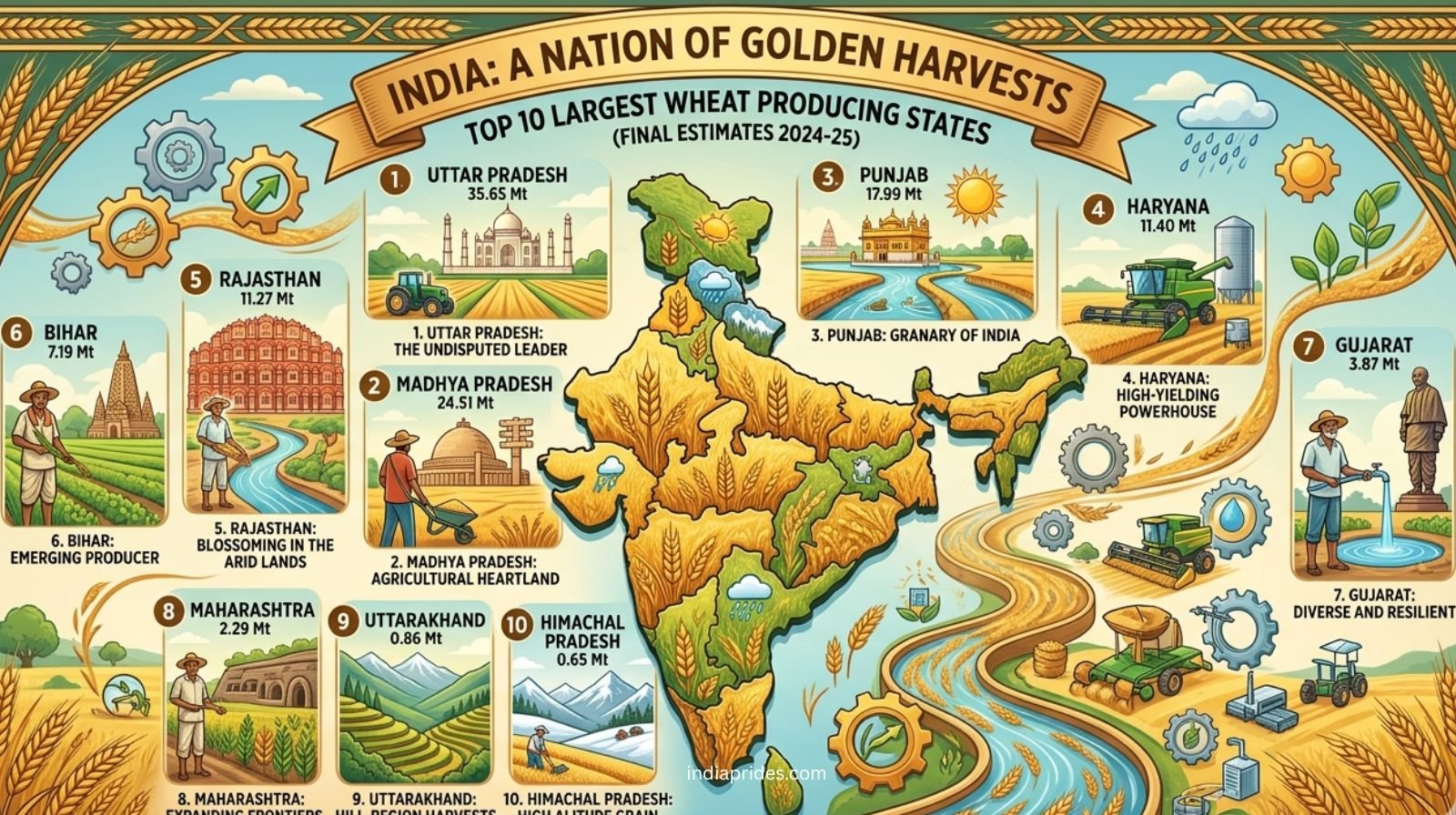
Wheat is the lifeblood of the Indian kitchen. From the soft rotis of the north to the artisanal breads appearing in urban cafes, this Rabi crop is a cornerstone of national food security. As of 2026, India remains the world’s second-largest producer of wheat, only trailing behind China. The “Green Revolution” might have started decades ago, but the technological and yield-based evolution continues across the fertile plains of the subcontinent.
In this deep dive, we are exploring the top 10 largest wheat producing states in India. These states are the agricultural engines that feed over 1.4 billion people and contribute significantly to the global grain market. If you are looking for the largest wheat producing state in India, you are about to discover why certain regions have become the “breadbaskets” of the nation.
1. Uttar Pradesh: The Unrivaled Leader
For years, Uttar Pradesh has held the crown as the largest wheat producing state in India. Its sheer geographical size combined with the fertile Indo-Gangetic plains makes it an agricultural powerhouse.
- Massive Output: UP contributes approximately 30% to 31% of India’s total wheat production.
- Fertile Basin: The state benefits from the alluvial soil deposited by the Ganges and Yamuna rivers, which is perfect for wheat roots.
- Key Districts: Regions like Azamgarh, Jaunpur, and Bulandshahr are massive contributors to the state’s multi-million-tonne harvest.
- Scale of Farming: With nearly 9.6 million hectares under wheat cultivation, its scale is simply unmatched by any other state.
2. Madhya Pradesh: The New Agricultural Heart
In recent years, Madhya Pradesh has seen a meteoric rise, often surpassing Punjab in total production volume to secure the second spot.
- Black Soil Magic: The central plateau’s Malwa region provides unique soil conditions that produce high-quality wheat, including the premium Sharbati variety.
- Irrigation Boost: Significant government investment in canal and tube-well irrigation has turned previously dry tracts into lush wheat fields.
- Production Share: MP now accounts for roughly 19% to 20% of the national output, firmly establishing it as a top largest wheat producing state in India contender.
3. Punjab: The Traditional Breadbasket
While Punjab may be smaller in size than UP or MP, it is a giant in terms of productivity and yield.
- Highest Yield: Punjab consistently records the highest wheat yield per hectare in India, often exceeding 5.0 tonnes per hectare.
- Advanced Mechanics: Punjab’s farmers are among the most technologically advanced, using modern combine harvesters and precision seeding.
- FCI Procurement: A massive portion of the wheat procured for India’s Public Distribution System (PDS) comes from the Mandis of Punjab.
- Cultural Legacy: In Punjab, wheat isn’t just a crop; it’s a way of life, celebrated through festivals like Baisakhi.
4. Haryana: The High-Performance Neighbor
Mirroring the success of Punjab, Haryana plays a critical role in filling the national granaries. It remains a consistent top-four player in the list of largest wheat producing state in India rankings.
- Strategic Location: Proximity to the capital and excellent road infrastructure allows for rapid grain movement.
- Research Hubs: Home to prestigious agricultural universities, Haryana farmers are often the first to adopt new high-yielding varieties (HYV) like HD 2967.
- Intensive Farming: Despite its smaller land area, its contribution of over 11 million tonnes is vital for national stability.
5. Rajasthan: Farming Against the Odds
It is often surprising to many that a desert state ranks so high. However, Rajasthan has mastered the art of “arid-land” farming.
- The IGNP Impact: The Indira Gandhi Canal Project has transformed districts like Sri Ganganagar and Hanumangarh into green belts.
- Resilient Varieties: Farmers here use drought-tolerant seeds that can thrive with minimal water.
- Quality Grain: Rajasthan’s wheat is often prized for its high protein content and hardness, making it ideal for flour mills.
6. Bihar: The Eastern Powerhouse
As we move east, Bihar emerges as a significant player. The state’s climate and soil are highly conducive to the Rabi season.
- Climate Advantage: The cool winters of Bihar are perfect for the grain-filling stage of the wheat plant.
- Rising Productivity: With better access to electricity for irrigation, Bihar’s yields have been steadily increasing over the last decade.
- Northeastern Supply: Bihar serves as a crucial supply point for the northeastern states of India.
7. Gujarat: Excellence in the West
Gujarat’s agricultural story is one of efficiency and diversification. While famous for cotton and groundnuts, its wheat production is world-class.
- Specialty Wheat: Gujarat is famous for Durum wheat, which is used globally to make pasta and semolina (suji).
- Technological Integration: Drip irrigation and soil health cards have helped Gujarat farmers optimize their inputs.
- Export Focus: Given its long coastline and ports, Gujarat is a strategic hub for any potential wheat exports from India.
8. Maharashtra: Diversity in the Deccan
While Maharashtra is the leader in sugarcane and cotton, its wheat production in the Vidarbha and Marathwada regions is essential for regional food security.
- Winter Crop: Wheat serves as a vital secondary crop for farmers after the Kharif harvest.
- Micro-Irrigation: The state has been a pioneer in using water-saving technologies to grow wheat in rain-shadow regions.
9. Uttarakhand: The Himalayan Contribution
The fertile valleys of Uttarakhand, especially in the Udhamsingh Nagar district, contribute a significant amount of high-quality grain.
- Terai Region: The foothills of the Himalayas provide a unique micro-climate that produces a very distinct flavor of wheat.
- Organic Potential: There is a growing movement in the state toward organic wheat farming, catering to the premium urban markets.
10. West Bengal: The Rice Giant’s Pivot
West Bengal is the “Rice King” of India, but it has made significant strides in wheat production to diversify its agricultural output.
- Late Sowing: Farmers in Bengal have mastered late-sown wheat varieties that fit perfectly into the window after the Paddy harvest.
- Food Security: Local production reduces the state’s dependence on grain transported from the northern states.
The Science of the “Golden Grain” in 2026
What makes a state a largest wheat producing state in India? It isn’t just luck; it’s a combination of three critical factors:
- Soil Quality: Alluvial and loamy soils are the best for moisture retention.
- Climate: Wheat needs a cool growing season and a bright, warm ripening period.
- Irrigation: Since wheat is a Rabi crop, it relies on “winter rains” (Western Disturbances) or canal water.
Challenges Facing Wheat Production in 2026
Despite record-breaking harvests, the industry faces modern challenges:
- Climate Change: Sudden heatwaves in February and March can shrivel the grain, reducing the “test weight.”
- Water Scarcity: Over-extraction of groundwater in Punjab and Haryana is a major concern for future sustainability.
- Pest Resistance: New strains of “Yellow Rust” require constant research into resistant seed varieties.
Conclusion
India’s journey from a food-deficit nation to a global wheat exporter is a testament to its farmers. From the sprawling fields of Uttar Pradesh to the high-yield farms of Punjab, every state on this list contributes to the “Annadata” (Provider of Food) legacy. Understanding the largest wheat producing state in India rankings allows us to appreciate the complex logistics and hard work that goes into every single loaf of bread on our tables.