Every year, you get one day where the world revolves around you. You blow out candles, tear open wrapping paper, and eat far more cake than you probably should. But have you ever wondered why we perform these specific rituals? Why do we put fire on top of dessert? Why do some months have more parties than others?
The history and science of birth anniversaries are far more complex and hilarious than a simple party hat suggests. In this ultimate guide, we are uncovering the top 10 birthday fun facts that range from ancient superstitions to modern mathematical paradoxes. Whether you are turning 5 or 95, these birthday fun facts will give you plenty of trivia to share at your next big bash!
1. The Egyptians Invented Birthdays (for Gods)
We often think of birthdays as a celebration of a person’s biological entrance into the world. However, the first recorded “birthdays” in history were actually for Pharaohs in ancient Egypt.
- Godly Transition: In ancient Egypt, when a Pharaoh was crowned, they were considered to be “born” as a god. It was this coronation date—the birth of a deity—that was celebrated, not the day they physically left the womb.
- Bible Reference: The first mention of a birthday celebration in the Bible (Genesis 40:20) is actually a reference to an Egyptian Pharaoh’s feast.
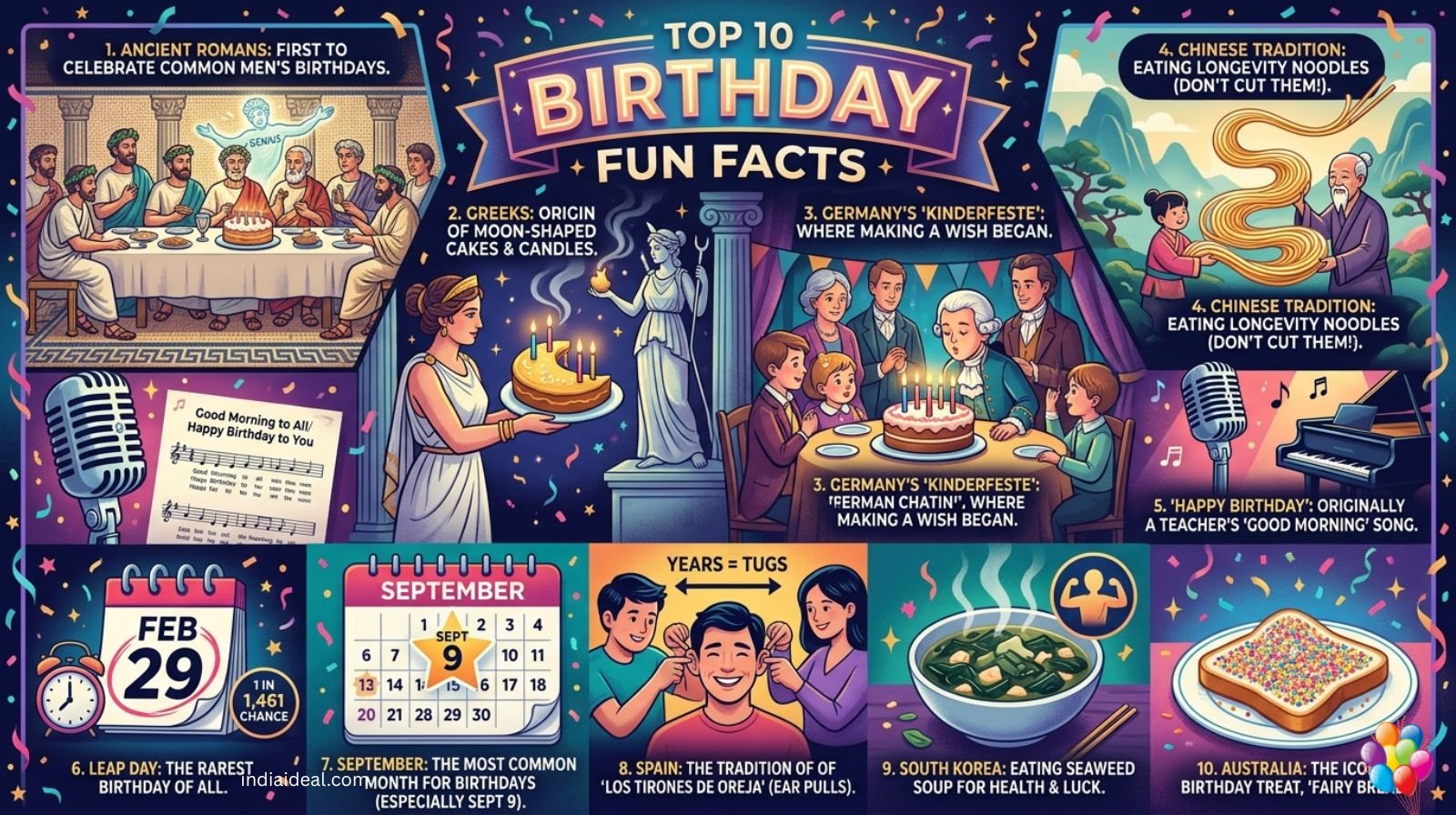
- Evolution: It wasn’t until the Romans came along that birthdays began to be celebrated for common people (though, initially, only for men!).
2. We Blow Out Candles to Talk to the Gods
The act of placing candles on a cake isn’t just for a pretty Instagram photo; it’s an ancient communication method. This is one of the most spiritual birthday fun facts on our list.
- Artemis and the Moon: The ancient Greeks would bake moon-shaped honey cakes for Artemis, the goddess of the moon. They placed lit candles on the cake to make it glow like the moon’s radiance.
- Prayer Smoke: It was believed that the smoke from the blown-out candles carried your prayers and wishes all the way up to the gods on Mount Olympus.
- German Kinderfeste: By the 18th century, Germans popularized Kinderfeste, where a candle was lit for each year of a child’s life, plus one extra for the “light of life.”
3. The “Birthday Paradox” is Real Math
You might think sharing a birthday is a rare occurrence, but mathematics proves that the world is much smaller than we think.
- The 23 Rule: In a room of only 23 people, there is a 50% chance that at least two people share the exact same birthday.
- The 70 Rule: If you increase that crowd to 70 people, the probability of a shared birthday jumps to a staggering 99%.
- Coincidence: This is known as the “Birthday Paradox” because our brains aren’t wired to understand how quickly these probabilities stack up in a small group.
4. Your Birth Month is a Popularity Contest
Statistically speaking, you are much more likely to be born in certain months than others. Nature seems to have a preferred schedule for new arrivals.
- August and September: These are consistently the most common birth months globally.
- The “Holiday” Factor: If you count back nine months from September, you land squarely in December and January—the holiday season. This explains why there are so many “Virgos” and “Libras” in the world!
- Rare Dates: February 29th (Leap Day) is the rarest birthday, but outside of that, Christmas Day and New Year’s Day see the fewest births because hospitals schedule fewer C-sections and inductions on major holidays.
5. “Happy Birthday to You” Was Once a Legal Battle
The song we all sing—often off-key—is the most recognized song in the English language. But for decades, you technically had to pay to sing it in public!
- Sisters Hill: The melody was written in 1893 by sisters Mildred and Patty Hill, originally titled “Good Morning to All.”
- Copyright Chaos: For years, the song was copyrighted by Warner/Chappell Music, earning them an estimated $2 million a year in licensing fees from movies and TV shows.
- Public Domain: In 2016, a judge finally ruled that the song belongs to the public domain. Now, everyone can sing it for free without fear of a lawsuit!
6. Many Cultures Share the “First Slice” Rule
How you cut the cake can be just as important as the flavor itself. In many parts of the world, the first slice is a symbol of deep respect or love.
- Brazil: In Brazil, the birthday person gives the first slice of cake to the person they love the most—usually a parent or a sibling.
- Mexico: The tradition of “La Mordida” involves the birthday person’s face being shoved into the cake for the first bite while everyone yells “Mordida!” (Bite!).
- Fortune Telling: In Malta, a child’s first birthday involves the Quċċija, where the baby crawls toward various objects. The object they pick (a book, a ball, a stethoscope) is said to predict their future career.
7. You Are Traveling at Insane Speeds Between Birthdays
If you feel tired on your birthday, it might be because you’ve just completed a massive cosmic journey.
- The Sun’s Orbit: From one birthday to the next, the Earth travels roughly 584 million miles around the sun.
- Atomic Level: If you lived to be 80 years old, you would have traveled approximately 46 billion miles through space.
- Time Tracking: On your 21st birthday, you have been alive for approximately 662,256,000 seconds. That is a lot of heartbeats!
8. The “Golden Birthday” and “Leaplings”
There are specific types of birthdays that only happen once in a lifetime—or once every few years—making them extra special in the world of birthday fun facts.
- Golden Birthday: This occurs when you turn the age of the date you were born on (e.g., turning 25 on the 25th).
- Leaplings: People born on February 29th only get a “real” calendar birthday every four years. Many choose to celebrate on February 28th or March 1st in non-leap years.
- The 60-Year Cycle: In Chinese culture, your 60th birthday is the most important. It signifies the completion of a full cycle of the zodiac (12 animals x 5 elements), essentially meaning you are starting a “new life.”
9. Noise Makers Ward Off Evil Spirits
Have you ever wondered why we use loud party blowers and shout “Happy Birthday”? It wasn’t always just for fun.
- Ancient Superstition: In many early cultures, it was believed that people were more vulnerable to evil spirits on their birthdays because they were undergoing a major life change.
- Scaring Spirits: Noise makers, cheering, and fire (candles) were used to frighten away these spirits.
- Good Wishes: Bringing gifts and well-wishes wasn’t just about being nice; it was a way to surround the person with “good energy” to protect them from bad luck for the coming year.
10. Strange Laws and Customs Around the Globe
Some countries take birthdays very seriously, with traditions that might seem a little painful or messy to outsiders!
- Canada: In parts of Atlantic Canada, it is common to ambush the birthday person and grease their nose with butter. This makes them too “slippery” for bad luck to stick to them.
- Ireland: The “Birthday Bumps” are a classic. The person is held by their arms and legs and bumped onto the floor once for each year of their age, plus one for extra luck.
- Vietnam: In traditional Vietnamese culture, individual birthdays aren’t always celebrated. Instead, everyone becomes one year older on Tết (the Vietnamese New Year).
Why Birthday Traditions Keep Us Connected
In 2026, as our lives become increasingly digital, the physical act of gathering for a birthday remains one of the few universal human experiences. Whether it’s a simple Fairy Bread feast in Australia or a massive Quinceañera in Mexico, these celebrations ground us in our personal history.
These birthday fun facts show that while the way we celebrate changes, the core reason remains the same: we want to feel seen, loved, and protected as we move through the journey of life. So, the next time you see those candles flickering, remember you are part of a 5,000-year-old global tradition.
Conclusion
From the rarest birth dates to the legal history of a simple song, birthdays are a fascinating mix of science, math, and mystery. These top 10 facts remind us that every year on this planet is a record-breaking achievement. Happy birthday to you—whenever it may be!