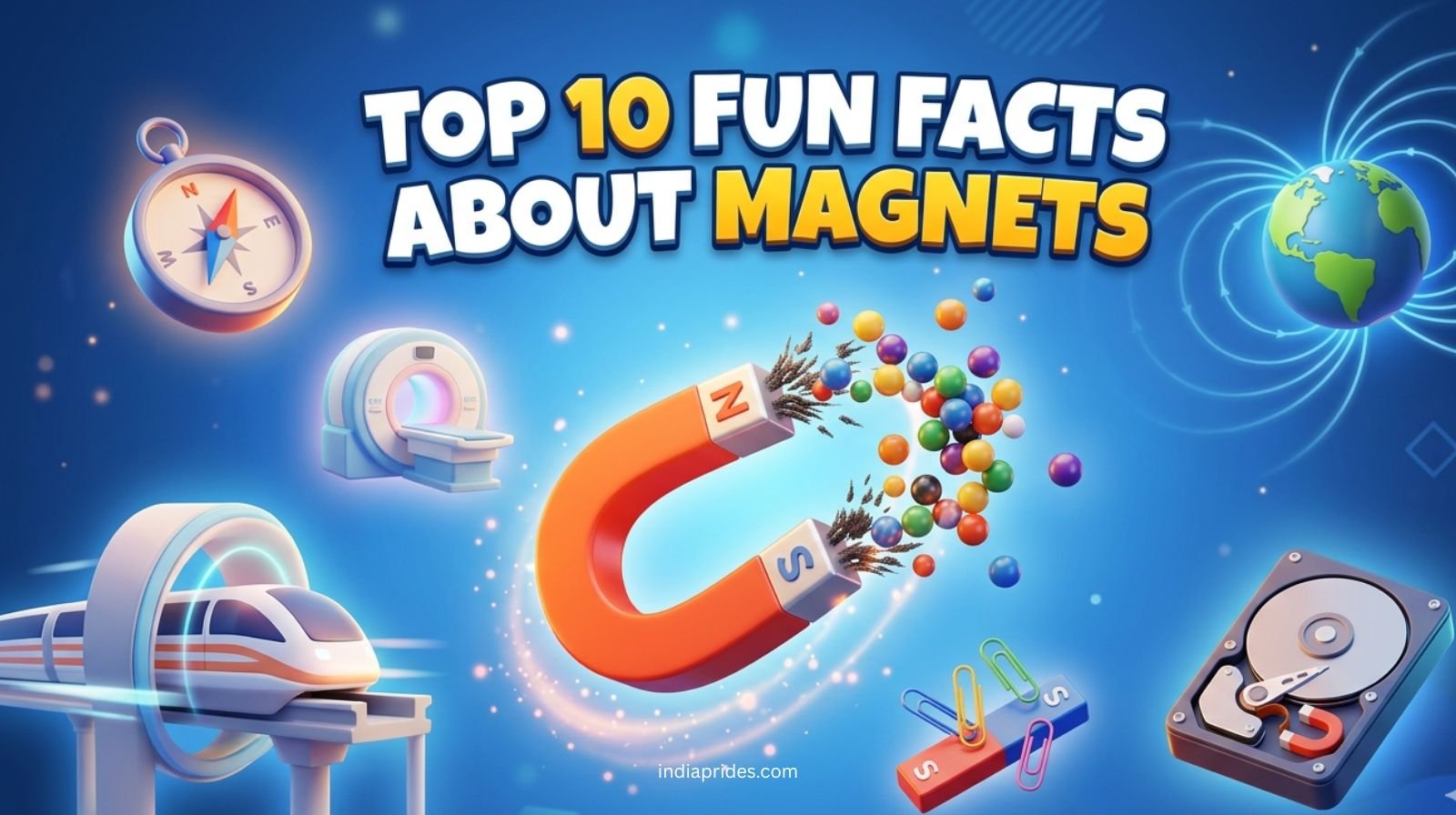
In the technologically supercharged world of 2026, magnets are the silent architects of our reality. They are hidden inside your high-speed Maglev trains, powering the motors of electric vehicles (EVs), and even keeping your foldable smartphone screen snapped shut.
But magnetism is far more than just a force that sticks a grocery list to your fridge. It is a fundamental pillar of the universe, a force that governs everything from the behavior of subatomic particles to the protection of our entire planet from cosmic radiation. Get ready to have your perspective shifted as we explore the top 10 fun facts about magnets that prove the world is much more “attractive” than you ever imagined.
1. Earth is One Giant Bar Magnet (With a Moving Soul)
The most important magnet in your life isn’t on your refrigerator—it’s the planet you’re standing on.
- The Geodynamo: Earth’s core is made of molten iron and nickel. As it flows, it creates electric currents, which in turn generate a massive magnetic field.
- The Protective Shield: This field, known as the magnetosphere, acts as a deflector shield against lethal solar winds and cosmic rays. Without it, our atmosphere would have been stripped away eons ago.
- Magnetic Flip: The North and South magnetic poles aren’t fixed! They swap places roughly every 200,000 to 300,000 years. Geologists say we are actually overdue for the next “Great Flip.”
2. Animals Have Built-in Biological Compasses
While humans need GPS or a physical compass, many animals have magnetoreception—the ability to sense Earth’s magnetic field directly.
- Migratory Birds: Many bird species have tiny crystals of magnetite in their beaks or specialized proteins in their eyes that allow them to “see” magnetic lines.
- Sea Turtles: These ancient navigators use the magnetic signature of the ocean to find their way back to the exact beach where they were born, thousands of miles away.
- The “Poop” Compass: Researchers have found that dogs frequently align themselves along the North-South magnetic axis when they go to the bathroom. Nature is full of surprises!
3. You Can Literally “Float” a Train Using Magnets
In 2026, the dream of friction-less travel is a reality thanks to Maglev (Magnetic Levitation) technology.
- Zero Friction: Maglev trains don’t have wheels that touch a track. Instead, they use superconducting magnets to hover about 10 centimeters above the guide-way.
- Record Speeds: By eliminating rolling friction, these trains can reach speeds of over 600 km/h, making them faster than many commercial airplanes on short-haul routes.
- The Propulsion Secret: The same magnetic force that lifts the train also pushes it forward using electromagnetic waves.
4. Some Magnets Are 100 Million Times Stronger Than Earth
We aren’t talking about the magnets in a science kit. We are talking about Magnetars.
- Stellar Power: A magnetar is a type of neutron star with a magnetic field so intense it’s hard to comprehend.
- Atomic Distortion: If a magnetar were located halfway to the moon, its magnetic pull would be strong enough to strip the data from every credit card on Earth and literally stretch the atoms in your body into thin strings.
- Rare Phenomena: These are the strongest known magnets in the universe, proving that magnetism is a force of cosmic destruction and creation.
5. There Is No Such Thing as a “One-Sided” Magnet
If you take a bar magnet with a North and South pole and snap it exactly in half, what do you get?
- Instant Regeneration: You don’t get a separate North and South. Instead, you get two smaller magnets, each with its own North and South pole.
- Magnetic Monopoles: While scientists have hunted for a “monopole” (a magnet with only one pole) for decades in the world of quantum physics, they have yet to find one in nature.
- Infinite Division: You can keep cutting a magnet down to the atomic level, and it will still retain its dipole nature.
6. Your Smartphone is a “Magnet Graveyard”
You are likely holding several powerful magnets right now. Modern electronics are completely dependent on rare-earth magnets.
- Speakers and Mics: Tiny neodymium magnets vibrate to create the sound you hear and capture the voice you speak.
- Haptic Feedback: That subtle vibration you feel when you type? That’s a tiny magnetic motor spinning at high speeds.
- Camera Stabilization: High-end 2026 smartphones use magnetic actuators to keep your camera lens steady, preventing blurry photos even if your hands shake.
7. Magnets Can Be “Turned Off” With Electricity
Not all magnets are “permanent.” The most versatile ones are electromagnets.
- The Discovery: In 1820, Hans Christian Ørsted discovered that an electric current creates a magnetic field around a wire.
- Adjustable Strength: By increasing the current or the number of wire coils, you can make the magnet stronger. Turn the power off, and the magnetism vanishes.
- Industrial Workhorses: This technology allows massive cranes in scrap yards to pick up a car and drop it exactly where they want just by flipping a switch.
8. Even Liquid Can Be Magnetic (Ferrofluids)
Magnetism isn’t just for solids. Enter the world of ferrofluids—liquids that become strongly magnetized in the presence of a magnetic field.
- Visual Art: When a magnet is brought near ferrofluid, the liquid forms incredible, spiky geometric patterns that look like something out of a sci-fi movie.
- Space Tech: NASA originally developed ferrofluids as a way to pump fuel in zero-gravity environments using magnets.
- Modern Uses: Today, they are used in high-end audio speakers to dampen vibrations and keep the voice coils cool.
9. MRI Machines: Using Magnets to See Inside You
One of the greatest triumphs of medical science is the MRI (Magnetic Resonance Imaging) scanner.
- Super-Magnets: An MRI uses a magnet roughly 3,000 times stronger than a typical kitchen magnet.
- Hydrogen Alignment: The machine uses this field to align the hydrogen atoms in your body. It then uses radio waves to knock them out of alignment and measures the energy they release when they snap back.
- Safe Imaging: Unlike X-rays, MRI technology uses non-ionizing magnetic radiation, making it a much safer way to get high-resolution images of soft tissues and organs.
10. Rare-Earth Magnets are the Key to a Green Future
As we transition to renewable energy in 2026, magnets have become more valuable than gold.
- Wind Turbines: Massive permanent magnet generators are required to turn the slow rotation of wind blades into electricity efficiently.
- Electric Vehicle Motors: Neodymium-iron-boron (NdFeB) magnets are essential for the lightweight, powerful motors that drive the EV revolution.
- Recycling Challenges: Because these magnets are so vital, “magnetic recycling” has become a massive industry to recover these rare materials from old electronics.
Conclusion: The Invisible Force Shaping Our Destiny
Magnets are far more than just toys or tools; they are the invisible threads that weave the fabric of our modern lives. From the magnetars in the deep reaches of space to the bio-compass in a migrating bird, magnetism is a force of constant wonder.
As we look further into 2026 and beyond, our ability to manipulate this force will lead to even cleaner energy, faster travel, and deeper medical insights. The next time you see a magnet, remember: you are looking at a small piece of the same power that protects our planet and drives the universe.
Frequently Asked Questions (FAQs)
Q: Can a magnet destroy my laptop or phone in 2026?
A: Most modern devices use Solid State Drives (SSDs), which are not affected by household magnets. However, very strong industrial magnets can still interfere with internal sensors or older hard drives.
Q: What is the strongest permanent magnet available?
A: The Neodymium magnet (specifically the N52 grade) is currently the strongest type of permanent magnet commercially available.
Q: Do magnets lose their power over time?
A: Permanent magnets lose their strength very slowly (about 1% every 10 years) unless they are exposed to extreme heat or strong opposing magnetic fields.