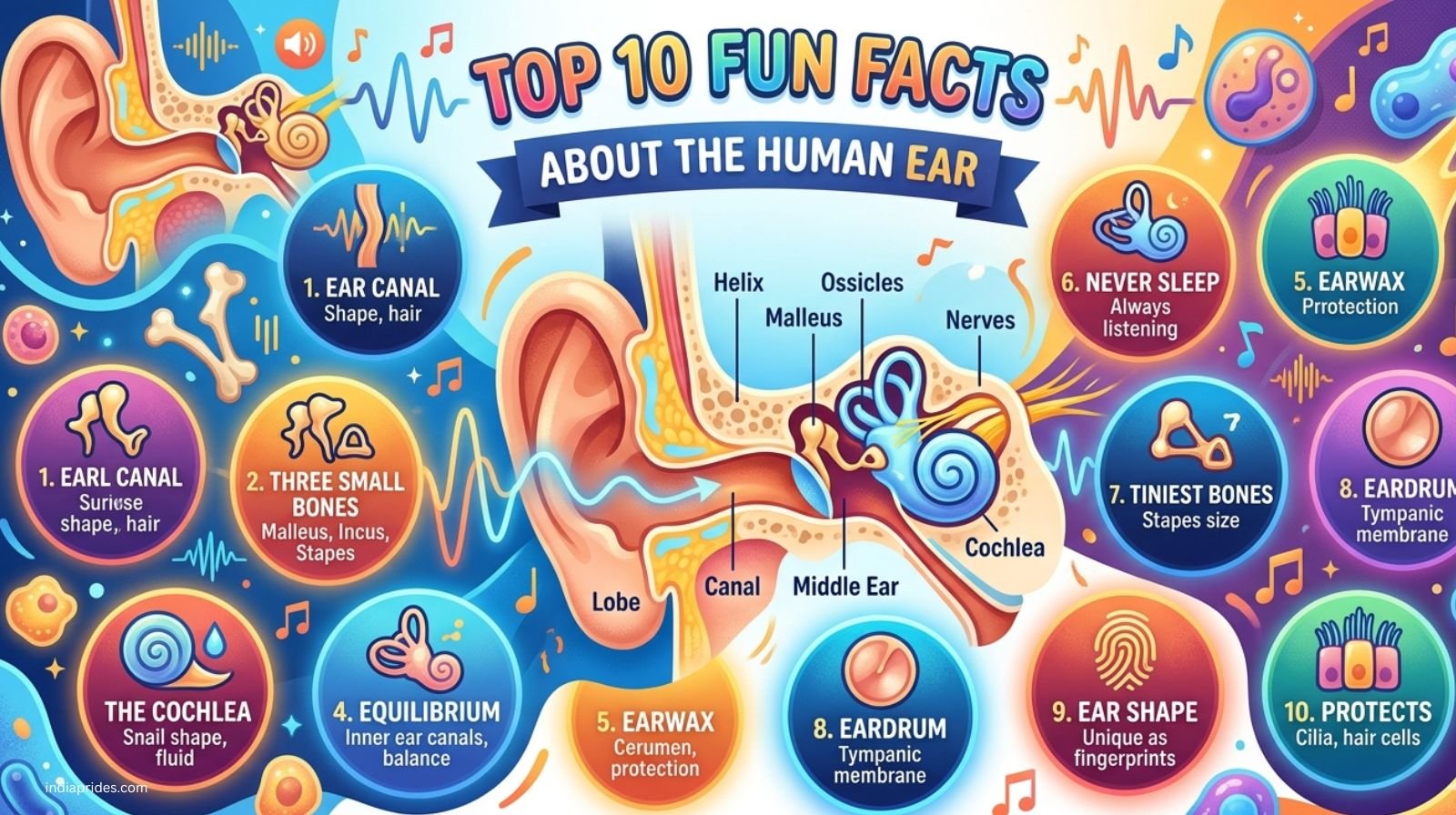
The human ear is a masterpiece of biological engineering. While we often take our Hearing for granted, these two small structures on either side of our heads are performing a complex, high-speed translation every second of every day. From maintaining our Physical Balance to allowing us to enjoy the nuances of a symphony, the ear is much more than just a flap of skin.
In this deep dive into Audiology and human biology, we explore the most mind-blowing secrets of the auditory system. Whether you’re a science enthusiast or just curious about your own body, these Ear Facts will make you listen to the world a little differently.
1. Your Ears Never Sleep (But Your Brain Does)
Did you know that your ears are 24/7 workers? Even when you are in a deep slumber, your ears continue to pick up Sound Waves and process them. However, the human brain has an incredible “filtering” mechanism.
While the ear is actively sending signals to the brain, the brain chooses to ignore them so you can stay asleep. This is why a sudden, unfamiliar noise (like a door creaking) can wake you up instantly, while the rhythmic sound of a fan or a ticking clock is filtered out as “safe.” Your Auditory System acts as a silent guardian while you rest.
2. The Smallest Bones in Your Body are in Your Ear
Human anatomy is full of surprises, but one of the most famous is found in the Middle Ear. The three smallest bones in the human body—the Malleus (Hammer), the Incus (Anvil), and the Stapes (Stirrup)—are located here.
How small are they? To put it into perspective:
- All three bones can fit together on the surface of a single penny.
- The Stapes is the smallest of the three, measuring roughly 3mm by 2.5mm.
- Despite their size, they are essential; they amplify sound vibrations before they reach the inner ear. Without these tiny “ossicles,” you would experience significant Hearing Loss.
3. Your Ears are Responsible for Your Balance
Most people associate ears strictly with hearing, but they are actually the primary organ for Equilibrium. Inside your Inner Ear, there are three tiny, fluid-filled loops called Semicircular Canals.
As you move your head, the fluid inside these canals shifts, moving microscopic hairs that send signals to your brain about your position in space. This is why you feel dizzy after spinning in circles—the fluid keeps moving even after you stop, confusing your brain’s sense of Balance.
4. Ears are Self-Cleaning Machines
If you are a fan of using cotton swabs, science has a message for you: Stop! Your ears are naturally designed to be Self-Cleaning.
Earwax (technically called cerumen) is not “dirt.” It is a specialized secretion that has Antibacterial and antifungal properties. It traps dust and small particles, preventing them from reaching the delicate Eardrum. Through the natural movement of your jaw (talking and chewing), the old wax is slowly pushed out of the ear canal, carrying debris with it.
5. Your Ears Can Affect Your Sense of Taste
It sounds like science fiction, but your ears and your tongue are secretly connected. A specific nerve called the Chorda Tympani runs through the middle ear on its way to the brain.
This nerve carries taste signals from the front two-thirds of your tongue. Because of this proximity, some people who undergo Ear Surgery or suffer from middle ear infections report a strange metallic taste in their mouth. It is a fascinating example of how interconnected our Sensory Organs truly are.
6. The Hardest Bone in Your Body Protects Your Ear
While many believe the femur (thigh bone) is the toughest, the title for the hardest bone in the human body actually goes to the Temporal Bone.
Located at the side and base of the skull, this bone houses and protects the incredibly delicate structures of the Inner Ear. Evolution has prioritized the protection of our hearing and balance by encasing them in the body’s most formidable “armor.”
7. Your Ears Never Stop Growing
Have you ever noticed that elderly people often seem to have larger ears? It isn’t just your imagination. While most of your body stops growing after puberty, your Outer Ear (the pinna) continues to get larger throughout your entire life.
Strictly speaking, it isn’t “growth” in the sense of new cells being added. Instead, it is due to Gravity and the breakdown of collagen and elastin in the cartilage. Over time, gravity pulls on the ear, causing it to stretch and expand.
8. You Have 20,000 “Hairs” Inside Your Ears
The “hairs” in your ear aren’t like the hair on your head. Known as Cilia, these are microscopic sensory cells located in the Cochlea (a snail-shaped structure in the inner ear).
These cilia are responsible for converting mechanical sound vibrations into electrical impulses that the brain can understand.
Warning: Once these hair cells are damaged by Loud Noises or aging, they do not grow back. This is why protecting your ears at concerts or construction sites is vital for long-term Ear Health.
9. Sound Travels at Different Speeds to Reach You
Your brain is a master of “Stereo Sound.” Because your ears are located on opposite sides of your head, sound usually reaches one ear slightly before the other (a difference of about 30 microseconds).
The brain uses this tiny time delay and the difference in Sound Intensity to calculate exactly where a noise is coming from. This is known as Sound Localization, and it is what allows you to turn your head toward someone calling your name without even thinking about it.
10. You “Hear” with Your Brain, Not Just Your Ears
While the ear is the hardware that catches the sound, the Auditory Cortex in your brain is the software that interprets it.
Your ears collect “vibrations,” but your brain turns them into “music,” “speech,” or “warning sirens.” This is why people with Tinnitus (ringing in the ears) often “hear” sounds that aren’t actually present in the environment—it is the brain’s way of trying to fill in the silence caused by hearing damage.
Conclusion: Value Your Auditory Health
The human ear is a delicate, self-sustaining, and multi-functional marvel. From the Temporal Bone to the microscopic Cilia, every part of the ear plays a role in how we perceive the world.
In a world that is getting louder every day, taking care of your Hearing is essential. Avoid excessive use of headphones at high volumes, give your ears a “silent break,” and appreciate the incredible biological engineering that allows you to hear the laughter of a friend or the notes of your favorite song.