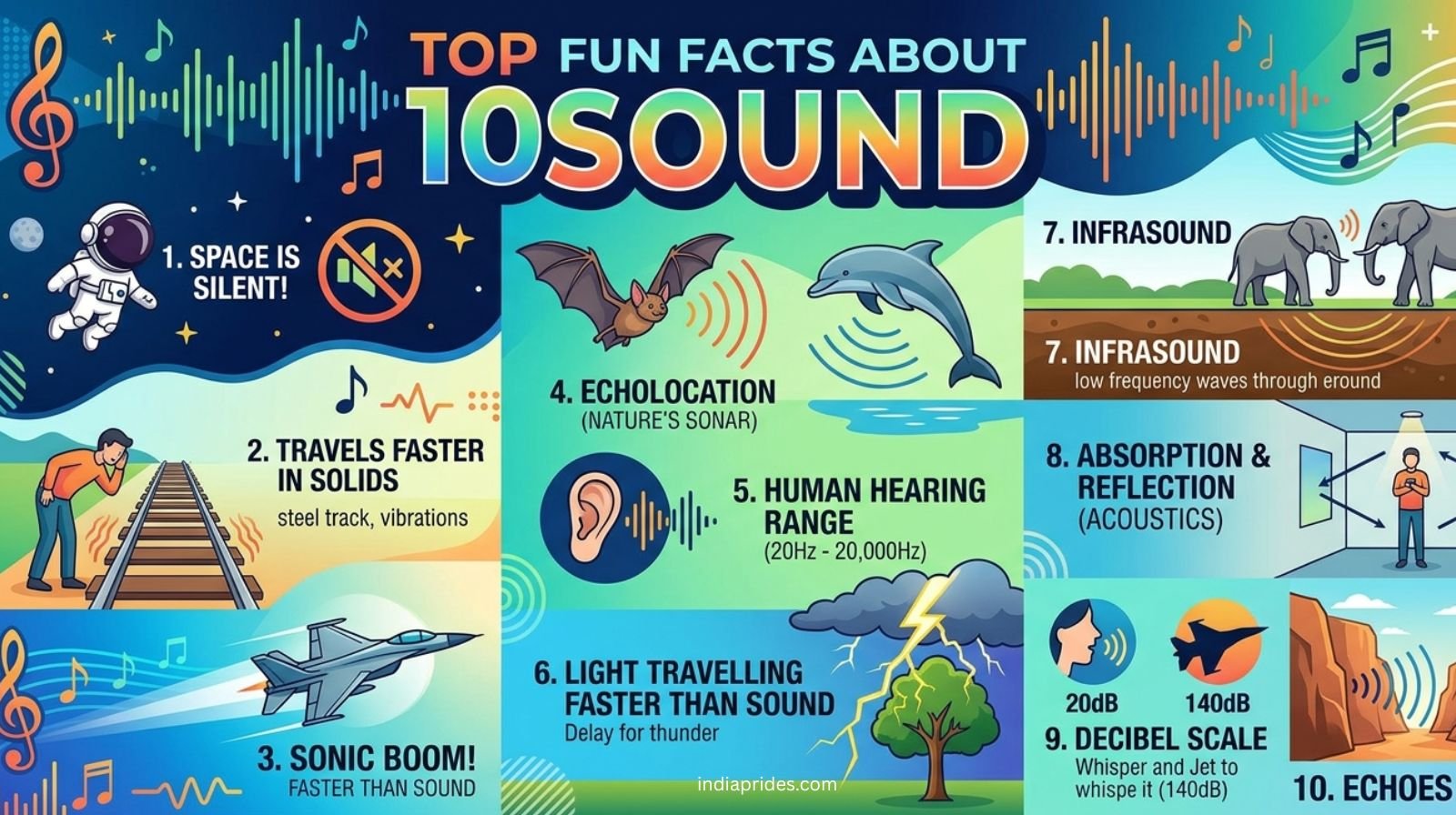
Sound is more than just a background track to our lives; it is a physical force, a biological trigger, and a mathematical marvel. From the subtle 32 Hz hum of a city to the deafening roar of a rocket launch, sound shapes our mood, our health, and our understanding of the universe. In 2026, as we move toward haptic audio and acoustic fire suppression, the science of sound is breaking new boundaries.
Whether you are an audiophile, a science buff, or just curious about the world, these Top 10 fun facts about sound will pull back the curtain on the invisible waves vibrating all around you. Prepare to see (and hear) the world in a completely different frequency.
1. The Loudest Sound Ever Recorded: A Global Shockwave
In 1883, the Krakatoa volcano in Indonesia erupted with a force that defies modern comparison. It produced the loudest sound in recorded history, reaching an estimated 310 decibels (dB) at its epicenter.
- The Distance: The explosion was so powerful it was clearly heard as “cannon fire” by people in Australia and Mauritius—over 3,000 miles (4,800 km) away.
- The Physical Impact: The sound wave was so intense it ruptured the eardrums of sailors 40 miles away.
- Global Travels: The pressure wave from the blast was so massive that it circled the entire globe seven times over five days.
2. Space is Silent (But Not Completely Empty)
You’ve seen the Hollywood blockbusters where spaceships explode with a thunderous boom. In reality, space is completely silent. Sound is a mechanical wave that requires a medium (like air, water, or metal) to travel. Since space is a vacuum, there are no molecules to vibrate.
- The Exception: While you can’t hear traditional sound, space is filled with electromagnetic waves. Scientists use “sonification” to convert these radio and plasma waves into audible sounds, allowing us to “hear” the haunting hum of a black hole or the crackle of a solar flare.
- Astronaut Talk: Inside a spacecraft, sound works normally because of the pressurized air. However, during a spacewalk, astronauts must rely on radio waves—which don’t need a medium—to communicate.
3. Sound Can Extinguish Fires: The Future of Safety
In 2026, we are seeing the rise of acoustic fire extinguishers. It sounds like science fiction, but low-frequency sound waves (specifically deep bass) can actually put out flames by separating the burning fuel from the oxygen it needs to survive.
- How it Works: Sound waves move air back and forth. At the right frequency (usually around 30 to 60 Hz), the wave creates a high-pressure zone that essentially “blows out” the fire like a giant invisible candle.
- The Benefit: This technology is ideal for server rooms or spacecraft where traditional water or chemical extinguishers would cause massive damage.
4. Sound Travels 4 Times Faster Underwater
If you have ever gone diving, you know that sound feels strangely clear and omnipresent. This is because water is denser than air, allowing sound waves to move at roughly 1,480 meters per second.
- Solids are Even Faster: Sound travels even faster through solids. In steel, sound moves at a staggering 5,000 meters per second.
- The Train Track Trick: This is why you can hear a train coming by putting your ear to the track long before you can hear it through the air. The molecular density of the metal transmits the energy much more efficiently.
5. A Crying Baby is Designed to Be Unignorable
Evolution has fine-tuned the human ear to be most sensitive to frequencies between 2,000 and 5,000 Hz. Coincidentally (or perhaps not), this is the exact frequency range of a crying baby.
- The Decibel Trap: A baby’s cry can reach levels of 110 to 120 dB, which is technically louder than a car horn or a power saw at close range.
- Biological Trigger: This specific pitch triggers a stress response in the human brain, releasing cortisol and making it physically impossible for a caregiver to ignore the sound for long.
6. Whips Crack Because They Break the Sound Barrier
The “crack” of a whip isn’t the leather hitting the ground—it’s actually a mini sonic boom.
- The Physics: As the loop of the whip travels toward the tip, it gains velocity. The very tip of a professional bullwhip can reach speeds of over 767 mph (1,234 km/h).
- The Result: When the tip exceeds the speed of sound, it creates a shockwave. You are literally hearing a piece of leather outrun its own noise!
7. Animals Hear a World We Cannot Imagine
Human hearing is limited to a range of 20 Hz to 20,000 Hz. Many animals live in “sonic dimensions” that are invisible to us.
- Infrasound: Elephants and whales use infrasound (low-frequency sound below 20 Hz) to communicate across hundreds of miles. These sounds are so deep they can be felt in the ground before they are heard.
- Ultrasound: Bats and dolphins use ultrasound (above 20,000 Hz) for echolocation. They “see” with sound, creating a 3D map of their surroundings that is more precise than our best sonar technology.
8. Absolute Silence Can Make You Hallucinate
The quietest place on Earth is an anechoic chamber (like the one at Microsoft’s headquarters). These rooms are designed to absorb 99.99% of all sound.
- The Experience: When you enter such a room, the silence is so heavy it becomes oppressive. Without external noise, your brain begins to amplify internal sounds. You can hear your heart beating, your lungs inflating, and even the sound of your own joints grinding.
- The Limit: Most people cannot stay in total silence for more than 45 minutes. After that, the brain, starved for sensory input, often begins to create auditory hallucinations.
9. Music Can Literally Change Your Brain Chemistry
Sound isn’t just processed by the ears; it “lights up” almost every part of the human brain. Listening to your favorite music can release dopamine, the same “feel-good” chemical released during eating or exercise.
- Physical Healing: In 2026, music therapy is being used to help patients with Parkinson’s and Alzheimer’s. Rhythmic beats can help patients with movement disorders find a steady “pace” for walking, effectively rewiring the brain’s motor pathways.
- Productivity Boost: Studies have shown that white noise or lo-fi beats can improve focus by masking distracting “spikes” in background noise, making them essential for modern office environments.
10. The Pistol Shrimp: The Loudest Animal in the Ocean
You might think the Blue Whale is the loudest, but the tiny Pistol Shrimp gives it a run for its money. It has a specialized claw that snaps shut so fast it creates a “cavitation bubble.”
- The Heat: When the bubble collapses, it produces a sound reaching 210 dB—louder than a jet engine.
- The Flash: For a fraction of a second, the pressure inside the bubble generates temperatures nearly as hot as the surface of the sun (4,700°C) and emits a tiny flash of light called sonoluminescence.
- The Weapon: The shrimp uses this “sonic gun” to stun or kill small fish and crabs instantly.
How Sound Shapes Our World in 2026
As we move forward, our mastery of sound is leading to incredible innovations:
- Acoustic Levitation: Using sound waves to hover small objects in mid-air for touchless assembly in laboratories.
- Sound Masking: Advanced office systems that use “pink noise” to ensure private conversations aren’t overheard in open-plan spaces.
- Haptic Audio: Wearable tech that allows you to “feel” the bass and vibrations of a movie or game through your skin.
Conclusion: Listen Closer
The world is a noisy, vibrant, and fascinating place. These top 10 fun facts about sound remind us that what we “hear” is only a small fraction of the energy moving through our environment. Whether it’s a whip breaking the sound barrier or a shrimp creating the heat of the sun, sound is a powerful force that connects us all.
Next time you put on your headphones or listen to the rain, remember: you aren’t just hearing a noise; you are experiencing the vibrational energy of the universe.