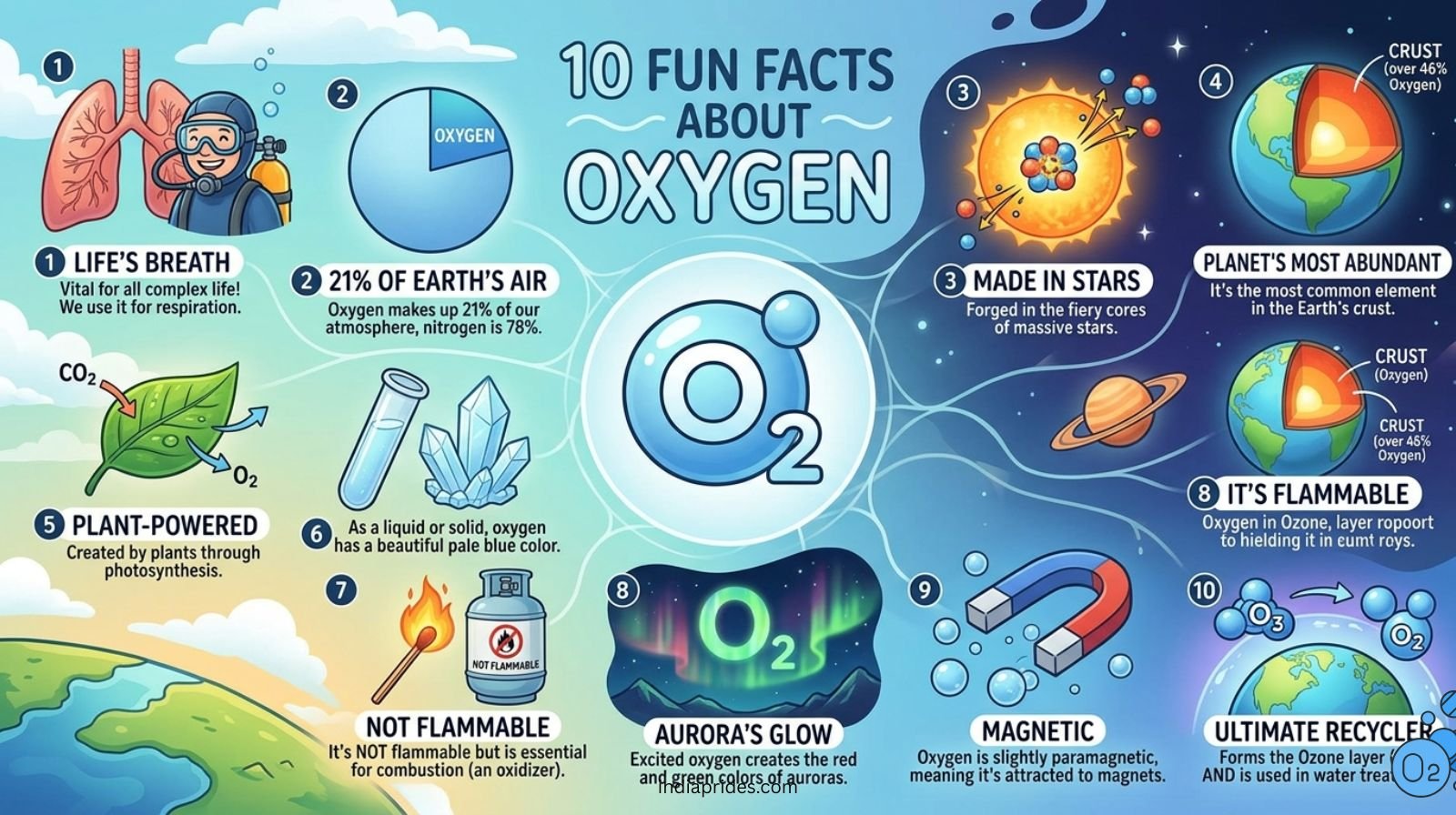
We often take it for granted, but every few seconds, you are performing a miracle: you are pulling in a colorless, odorless gas that fuels every single cell in your body. In 2026, as we push further into space exploration and deep-sea research, our understanding of oxygen has never been more vital. It is the third most abundant element in the universe, yet it remains shrouded in mystery for the average person.
Oxygen isn’t just about breathing; it’s about the chemistry of life, the blue of our skies, and even the power of our rockets. Whether you’re a science buff or just curious about the world around you, these Top 10 fun facts about oxygen will change the way you think about every breath you take.
1. Oxygen is Actually Pale Blue (In Its Coolest Forms)
We think of oxygen as invisible because, as a gas, it has no color, smell, or taste. However, if you cool it down to an extreme -183°C (-297°F), it condenses into a liquid. At this stage, and even when it freezes into a solid, oxygen takes on a beautiful, clear, pale blue color.
- The Science: This sky-blue tint happens because of the way oxygen molecules absorb specific wavelengths of light when they are packed tightly together.
- Liquid Power: This blue liquid is incredibly powerful and is commonly used as an oxidizer in rocket propulsion systems, including those launched by SpaceX and NASA.
2. It Is the Master of Disguise: Oxygen in the Earth’s Crust
While we look for oxygen in the air, the vast majority of it is actually right beneath your feet. Oxygen is the most abundant element in the Earth’s crust by mass, making up nearly 46% of the ground we walk on.
- The Compound King: It doesn’t sit there as a gas; it is bound up with other elements to form minerals like silica (sand) and various metal oxides (rocks).
- Massive Presence: Because water (H2O) is nearly 90% oxygen by mass, the oceans are essentially giant reservoirs of liquid oxygen atoms bound to hydrogen.
3. The “Great Oxidation Event”: Oxygen Was Once a Poison
About 2.4 billion years ago, Earth’s atmosphere had almost zero oxygen. It was only when ancient cyanobacteria began performing photosynthesis that oxygen levels started to rise.
- The Extinction: To the anaerobic life forms existing at the time, oxygen was a toxic waste product. This led to the Great Oxidation Event, one of the most significant extinction events in Earth’s history, paving the way for multicellular life—including humans.
- Legacy: Every breath you take today is thanks to that ancient “pollution” event that transformed the planet.
4. Oxygen is Paramagnetic: It Can Be Manipulated by Magnets
You might not think of a gas as being “magnetic,” but oxygen has a unique physical property called paramagnetism. If you pour liquid oxygen between the poles of a powerful magnet, it will actually get trapped and hang there in mid-air.
- The Reason: This happens because oxygen molecules have unpaired electrons that align with an external magnetic field.
- Experimental Fun: This property is a favorite for classroom demonstrations, showing that oxygen is far more than just “empty air.”
5. High Oxygen Levels Once Created Giant Dragonflies
During the Carboniferous period (about 300 million years ago), atmospheric oxygen levels were much higher than today—around 35% compared to our current 21%. This allowed insects to grow to monstrous sizes.
- The Meganeura: Dragonflies like the Meganeura had wingspans of over two feet! Since insects breathe through tiny tubes in their bodies rather than lungs, the high oxygen concentration allowed them to grow much larger than modern physics currently permits.
6. The Sun and Stars Are Oxygen Factories
Oxygen isn’t just an Earthly phenomenon; it’s a cosmic traveler. It is the third most abundant element in the universe, trailing only behind hydrogen and helium.
- Stellar Nucleosynthesis: Oxygen is forged deep inside the cores of massive stars (at least five times the mass of our Sun) through nuclear fusion.
- Cosmic Dust: When these stars reach the end of their lives and explode as supernovas, they scatter oxygen across the galaxy, which eventually clumps together to form planets and, eventually, life.
7. Too Much Oxygen Can Actually Be Lethal
We need oxygen to live, but in this case, you can have too much of a good thing. Breathing 100% pure oxygen at high pressure for extended periods can lead to oxygen toxicity.
- The Biological Toll: Excess oxygen creates reactive oxygen species (free radicals) that can damage cell membranes and lead to seizures or lung damage.
- Scuba Safety: This is a major concern for scuba divers and astronauts, who must carefully balance their breathing gas mixtures to stay within safe physiological limits.
8. Oxygen Is Responsible for the Aurora’s Colors
The breathtaking Aurora Borealis (Northern Lights) and Aurora Australis are essentially light shows powered by oxygen. When solar wind particles collide with atoms in Earth’s upper atmosphere, they “excite” them.
- The Green and Red: When excited oxygen atoms return to their normal state, they release photons. Oxygen is responsible for the most common green colors and the rarer, deep red hues seen in the night sky.
- Altitude Matters: The green light typically comes from oxygen at lower altitudes, while the red light originates from oxygen atoms higher up in the thermosphere.
9. Fish Don’t “Breathe” the Oxygen in H2O
It’s a common misconception that fish breathe the oxygen atom that is part of the water molecule (H2O). In reality, fish breathe dissolved oxygen gas (O2) that is trapped between the water molecules.
- The Gills: Gills are designed to extract this tiny amount of dissolved gas. This is why a fish can suffocate in water that has been boiled (which removes the dissolved gas), even though the water molecules themselves are still full of oxygen.
- Environmental Health: Checking dissolved oxygen levels is the primary way scientists measure the health of rivers and oceans in 2026.
10. The Mystery of Discovery: Three Men, One Gas
The discovery of oxygen was a messy affair involving three different scientists in the 1770s.
- Carl Wilhelm Scheele: Discovered it first in 1772 but was slow to publish his results.
- Joseph Priestley: Independently discovered it in 1774 and published his findings quickly, often getting the historical credit.
- Antoine Lavoisier: He was the one who realized it was a chemical element and gave it the name “Oxygen,” derived from the Greek words meaning “acid-former.”
Quick Oxygen Facts at a Glance:
- Chemical Symbol: O
- Atomic Number: 8
- Atmospheric Percentage: ~21%
- Boiling Point: -183°C
- Human Body: Roughly 65% of your body mass is oxygen (mostly in the form of water).
Conclusion: Respect the Invisible Hero
Oxygen is the ultimate silent partner. It burns our fuel, creates our steel, protects us from UV radiation (as ozone), and keeps our hearts beating. In 2026, as we look toward sustainable energy and carbon capture, understanding the cycle of this vital gas is more important than ever.
The next time you take a deep breath after a long run or stare up at the green glow of an aurora, remember that you are witnessing the incredible power of the eighth element on the periodic table.